By Christopher Blackwell
When we think of the Pagan religions of Europe, most of us consider the original religions long dead with only the reconstructions that exist today. But is that actually true? Did the old religions die out completely or did they hang on as folk lore, or did any of them manage to survive into the modern age? Here is one area that we might ask of Andras Corban-Arthen, who is the founder of EarthSpirit Community, one of the oldest Pagan groups still operating in our country.
Christopher: Could you give us a bit of background on yourself as a person?
Andras: My family of origin is Hispanic. On my father’s side they were mostly from Galiza, in northwestern Spain, which was the last outpost of Celtic civilization in that land. Though they have lost the original language, most Galegos to this day still consider themselves to be Celts, and that was an important part of the cultural context in which I grew up. My mother and her father were Cuban; her mother was Basque.
I grew up in Spain, in Cuba, in Florida and in Puerto Rico. We were living in Havana at the time of the Revolution, but left soon after; we were planning to go back to Spain, but things didn’t work out and we came to the U.S. instead. I was raised Roman Catholic, and spent a few years in a special school for boys whose families had destined them for the priesthood (I can still recite a lot of the old Tridentine Mass in Latin by memory), but I parted ways with Christianity when I was sixteen.
I’ve traveled a good bit, mostly throughout Europe and the Americas. I came to Massachusetts in the late sixties to go to college, and have lived here ever since – first in the Boston area, then for the past fifteen years in the countryside of the Berkshire hills, toward the western part of the state. My wife Deirdre and I have been together since 1980, and have a son and a daughter, ages 24 and 20. We are part of an intentional pagan family, about a dozen of us who’ve been together for close to three decades now.
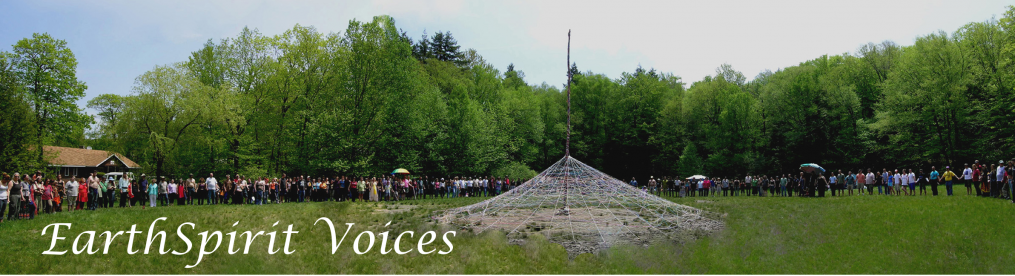
We live in Glenwood, a 135-acre working farm surrounded by thousands of acres of forest, which also serves as a pagan sanctuary and small conference center. Over the years, as a way to honor our relationship with this land, we’ve built a stone circle, a 60-foot-wide labyrinth, an Ancestor Shrine and a Peace Cairn. There are a lot of maples on the land, so we make our own maple syrup, and we have an organic garden that yields most of our produce for the year. We have lots of domestic and farm animals (dogs, cats, goats, sheep, chickens, turkeys, ducks, rabbits and a llama) and the land abounds with all sorts of wildlife. And we have a wealth of spiders.
As for what I do, I serve as spiritual director of the EarthSpirit Community, through which I’ve been full-time pagan ‘clergy’ since about 1980. My main work involves teaching, public speaking, community development, spiritual counseling, organizing events, officiating at ceremonies such as weddings and other rites of passage, and interacting with the media.
A good deal of my work has also been focused on interfaith dialogue and networking, particularly through the Parliament of the World’s Religions – I am a member of its board of trustees, and am currently coordinating its Ambassadors program, as well as serving as liaison to its partner organization in Guadalajara, México. I am also on the board of directors of the European Congress of Ethnic Religions, an organization headquartered in Vilnius, Lithuania, which promotes the revitalization of indigenous European paganism, and in which I serve as international interreligious liaison. And I am part of the advisory council of the Ecospirituality Foundation, an NGO based in Torino, Italy, which works with the United Nations on indigenous issues throughout the world.
Christopher: How long have you been Pagan? What path do you follow?
Andras: Officially, since the beginning of 1969, which is when I met my teachers. They were a married couple, about twice my age, who were part of what originally had been a Gaelic-speaking family from the Scottish Highlands (the man in the couple still spoke Gaelic fluently). The family had been forced to leave their homeland during the Clearances, and some of them eventually settled near Edinburgh. At the time I met the two of them, they had been in the Boston area for some time, pursuing graduate studies, though they eventually moved on.
I was told about them by a mutual friend, who, before agreeing to introduce us, pointedly warned me that they were ‘witches.’ That really piqued my curiosity, because the thought that there might actually be people in the late 20th century who considered themselves to be witches seemed so outrageously absurd to me that I had to check them out.
But they turned out to be quite different from what I’d expected – they were very intelligent and well-educated, but also very accessible and unassuming, and we hit it off right away. Our first couple of encounters included several remarkable ‘coincidences’ on both of our parts that left us with the sense that our meeting was somehow fated.
For me, it was definitely one of those things where you meet someone and you immediately feel like you’ve known them all your life, like they’re family. In particular, the things they told me about their spiritual practices somehow made far more sense and were more immediately appealing to me than anything else I had found. After a few weeks, as we started developing a friendship, I asked them if they would teach me, and they agreed to do so. I’ve been engaged in those practices ever since.
Christopher: Is this neopaganism or is there a tie to the ancient religions?
Andras: Their teachings were not neopagan, although, at the time, I had no way of knowing that, since I had no other frame of reference except what I was being taught. But several years later, after my teachers left the area and I was on my own, as I started to meet more and more neopagans it became disconcertingly obvious that what I had been taught was very different from what my new friends practiced.
One major difference is that neopaganism typically borrows isolated elements from many diverse cultures and creates a very eclectic synthesis of them.
Conversely, what I was taught came from one particular culture which was indigenous to a very specific part of the world; and the fact that I was not a member of that culture by birth or rearing, and that I was not being taught those practices in the land where they had originated, were both obstacles to my assimilation of the teachings, and there were certain compensations that I had to make to overcome those obstacles.
For my teachers, the idea that you could just take random bits out of a culture into which you hadn’t been assimilated didn’t make any sense – they thought it was like eating the skin of a fruit while leaving the pulp to rot.
There were many other important differences: for instance, my teachers’ practices were essentially animistic – they involved no belief in or worship of deities. At the core of their teachings was the experience of Mystery, of engaging the unknown directly, without attempting to explain it or shape it. Rituals (if they could really be called that) were very simple and mostly wordless affairs, which relied more on the execution of practices than on anything else – the kinds of ‘dramatic’ ceremonies that are so common in neopaganism, including the enactment of various mythological tableaux and such, played no part at all in what they did. We didn’t work in a circle, or invoke elements, or use specifically ‘magical tools.’
Most of their practices were meant to be engaged in a state of trance, which they had several different ways of attaining. The Gaelic term they used for ‘trance’ essentially means ‘mist’: you became ‘enmisted’ – in other words, you engaged a process that took you outside the ordinary world and, in so doing, gave you access to spiritual currents that enhanced you, and changed you, and shaped you. One of the ways they used for inducing the trance was communion with a particular mushroom – this is yet another difference, since many neopagans see such practices as dangerous or inappropriate.
All of their teachings were rooted in a sense that the natural world was the matrix, the source of life and spiritual wisdom and soul-strength, but to them, nature meant wilderness – environments that were not manipulated and controlled by humans. So we spent a lot of time in the woods, mostly outside the city, though there was a particular park near us that was pretty much abandoned and reverting to its natural state, where we could go in a pinch.
This is another way their teachings differed from neopaganism, in that they were adamant that I strive to experience the natural world as it really was, not as a symbol. In neopaganism, there’s a very common pattern of representing nature symbolically, as various aspects of the human condition (air is intellect, fire is passion, water is emotion, etc.) My teachers stressed the very opposite: in their approach, for instance, not only was fire never passion or any other human trait – it wasn’t even fire. To them, the very concept of ‘fire’ was itself a symbol that kept us from truly experiencing the essence of the force we call by that name. Some of their practices were meant to induce a state in which language became meaningless, and where the natural world could be perceived much more directly.
Because of my youth and lack of experience, while I was with my teachers it never really occurred to me to probe too deeply into the background of what they taught me; I pretty much accepted it at face value and focused on the practices themselves. My encounters with neopagan groups, which had such a different approach, made me want to get a more objective sense of what I had been taught. A couple of years after my teachers had left, an American Indian friend suggested that the teachings I had received from them might be the remnants of an indigenous (or, as he put it, ‘native’) tradition from the Highlands, and that some of the practices sounded very similar to shamanism.
So I started to read up on shamanism (this was many years before it became a New Age fad, so the information was not easy to come by), and that led me to a wider study of indigenous cultures. After a while, it became very clear to me that there were certain key elements which were consistently found among indigenous peoples throughout the world, and that those very elements were strikingly similar to a lot of what I had been taught. And then I realized that the old pagan cultures of Europe took on a whole new perspective – a richer, fuller meaning – if they were looked at in the context of indigenous traditions.
I also began to wonder that, if indeed, what I had been taught represented a survival of an indigenous pagan tradition – could there be others? Where could they be found? How might they be similar or different? So, I set myself the task of attempting to find out the answers to these questions.
Christopher: When we think of the old religions, most of us consider that they disappeared after the coming of Christianity. How could any of them survive, and in what form, into the modern age?
Andras: It’s hard to answer this briefly, because it’s a very complicated subject and not well-served by brevity or generalizations, but I’ll give it a try. Yes, conventional wisdom certainly holds that the old pagan traditions disappeared as a result of the Christianization of Europe, but one of the main problems with conventional wisdom is that it tends to get passed along unchallenged and untested. There’s a subtle but important distinction, for instance, between something ‘disappearing’ and something ‘ceasing to exist.’ It’s very clear that most of the pre-Christian European spiritual traditions have disappeared, because they’re not obviously present, not easily found. And, of course, it’s a good bet that most of them have also ceased to exist altogether. But was that actually true for all of them? How can we know that for sure?
It is quite well documented, for instance, that the Mari people in Eastern Europe have maintained their unbroken animistic pagan religion to the present, even after the Christianization of their country several hundred years ago. Could there be any other similar survivals elsewhere in Europe? Is it possible that some of those old traditions may actually have survived by ‘disappearing,’ by going underground?
I have now spent over thirty-five years trying to find such survivals, and it’s been a very difficult, painstaking process involving lots of correspondence, lots of phone calls, lots of travel. In that time I’ve met many people, both in Europe and in the Americas, who had practices that were obvious syncretisms of Christianity with traditional pagan elements, to varying degrees. Those are not that hard to find – you scratch the surface a bit, and there they are, far more common than perhaps many imagine.
I’ve tried to focus my search, however, on finding people who were preserving what I would consider unbroken, substantial survivals of traditional paganism – such as the Mari – that were as untainted as possible by Christianity (to the degree that anything in Western culture, including neopaganism or even atheism, could be ‘untainted’ by Christianity at this point). This has been a much more difficult process, because it has involved not only finding such people and making contact, but more importantly, gradually cultivating enough trust to get to the point where they were willing to meet with me and to answer some of my questions.
To date, I have found close to a dozen, in both Eastern and Western Europe. That’s not a lot, but if I’ve been able to find those with my relatively meager resources, I imagine there must be quite a few more out there.
I should make clear that these survivals are not widespread or out in the open. They mostly involve very small, isolated communities or even just a few families, whose practices and beliefs are either not known to most of their neighbors, or are tolerated by them. And they are not people living in little thatched huts, wearing medieval peasant garb, though their way of life tends to be substantially different from modern American urban culture.
The survivals I have found have certain key elements in common that I think have helped them to endure: They exist in fairly remote or ‘undesirable’ rural locations, in places where the original, ancestral languages are still spoken; this has provided them with a certain degree of insulation. They are in regions where there have been major sociopolitical upheavals which have destabilized the existing power structure and have taken the focus away from religious persecution or suppression.
They involve extended families or small communities that hold on to a very strong cultural identity and nationalistic sentiments, and particularly deeply-ingrained feelings of connection for the physical environment in which they live, and their ‘religions’ are very much an integral, vital part of their culture; in other words, they are not just trying to preserve their religion, but their entire way of life. And they involve people who bear a strong animosity – in some cases, hatred – toward Christianity, for reasons which range from the cultural and historical to the purely personal.
The people who preserve these traditions claim – as my own teachers did – that they are unbroken, that they have existed as far back as anyone can remember (in the sense of cultural, not individual memory, naturally). It is, of course, almost impossible to conclusively prove any of this because, first, any attempt to offer irrefutable proof would require them to expose themselves to public scrutiny, which they’re not at all likely to do, as it would mean giving up perhaps the most important thing that has allowed them to survive in the first place; and, second, most of them quite probably lack the kind of detailed documentation that would be needed for such proof to be truly conclusive.
Obviously, there’s a lot more that could be said about all this. For the past several years, I have offered a presentation entitled “The ‘Indians’ of Old Europe” (a title which was given to me by a Hopi elder), describing in greater detail some of my experiences, limited though they be, exploring the perspective of the old pagan cultures as indigenous traditions, as well as my efforts to find current survivals of them. I’m hoping to be able to offer it in book form by next year.
Christopher: When and why was EarthSpirit Community formed?
Andras: I founded EarthSpirit in 1977, originally as a bartering co-operative, in an attempt to start developing community by finding people who shared some of my own interests in nature spirituality, social activism and radical politics. When my wife Deirdre came along in 1980, we decided to turn EarthSpirit into a much more comprehensive and specifically pagan type of organization.
When I began meeting my first neopagans, one of the things that I found particularly confusing was that they were presenting paganism exclusively as a religion. My sense, based on the teachings I’d received as well as my own research, was that the old paganisms had not been stand-alone religions but, rather, cultural traditions that had spiritual practices and beliefs deeply integrated within them. To me, it seemed that in the interrelationship between culture and religion, the culture served as the vehicle through which the spiritual principles and values were incorporated into the everyday lives of the people.
But, if paganism was going to exist as a religion without a culture, how was it going to achieve that integration? The answer, it seemed clear, was that the automatic default would be mainstream American culture, which is inherently Christian (even in ways that are not so obvious) and seemed to embody the very opposite of the ideas and values that most neopagans I knew were professing to uphold. (Personally, I think that this particular conflict, and the resulting lack of integration, have only gotten worse over the years, and that they’re the source for a lot of the problems which so many modern pagans frequently complain about.)
So, as we envisioned EarthSpirit, we felt very strongly that its chief aim should be to help develop modern pagan culture and community – even if it had to be of a generic nature in order to include all of the people we were trying to reach – that could gradually help to identify traditional pagan values and eventually incorporate them in people’s lives.
In 1979, the year before Deirdre came, I had organized the first Rites of Spring gathering under the sponsorship of the Mass. Pagan Federation, a networking organization of which I had been one of the founding members. Unfortunately, as has happened with so many other pagan confederations over the years, the MPF disbanded right after the gathering, so Deirdre and I decided to continue organizing the event (which is now approaching its 34th year) [ed. note: ROS 36 will take place next month] under the aegis of EarthSpirit.
From then on, things began to develop very quickly. Our initial focus was to provide services for pagans in the Greater Boston area, so we began to offer public classes in various locations, as well as open seasonal rituals, various kinds of special-interest groups, a newsletter, a monthly coffeehouse, an ongoing study group, retreats, speakers, a film series, salon-style discussion groups, etc.
As the organization grew in numbers, we also began to acquire members from all over the Northeast, and eventually from various parts of the country. In response to our growing membership we added three more gatherings, began to publish a professionally-produced magazine, and developed our ritual performance ensemble, MotherTongue, which has performed nationally and internationally, and has produced several recordings. I also began to travel around the country a good bit, speaking at various conferences and offering presentations which were sponsored by some of our national members.
With the coming of the Internet, our numbers grew even more and we started getting members from other countries as well. This was around the same time that some of us moved to Glenwood, so our work evolved to yet another stage as we developed a website and an Internet presence, and began to offer programs and ceremonies at our new home. We developed Anamanta, which is a pagan spiritual practice adapted from the teachings I received, in an attempt to make them more accessible.
We also established several programs for young people, including EarthWise, a pagan summer camp, and EarthSpirit PeaceJam, a service-learning group for adolescents in collaboration with the PeaceJam Foundation, a wonderful organization that brings teen-agers together with Nobel Peace Prize laureates to develop projects around themes of social justice, peace, the environment, etc.
Obviously, work of this kind and scope is not something that one or two people can do by themselves. There’s a whole core group – well over a hundred of us – who work together to run the organization and manage the events. But it’s not just a question of how many, but also of how long – a lot of our core group has been involved in this work for ten to twenty years or more. I also think that we have been able to last as long as we have because for so many of us, what we do for EarthSpirit is part of our spiritual practice – whether we’re cooking a meal, teaching class, or putting stamps on fliers. And we are blessed to be part of a community that includes a lot of very creative and talented people – and generous, to boot: there’s no way we could do most of what we do (particularly our interfaith outreach) without their ongoing support.
One of the most rewarding things about the work we do is when that work gets shared and spreads throughout the community at large. For instance, I was just reading a new book, “Universal Heartbeat: Drumming, Spirit and Community,” by my friend Morwen Two Feathers, who is a long-time member of EarthSpirit, and I couldn’t help but reminisce on how things were in the old days. Back in the mid-seventies, when I was first exploring shamanism, I started to use a drum in my practices as a way to induce trance, and found it extremely effective. But when I took it to a couple of rituals organized by Wiccan friends, I got all kinds of flack about it because, after all, the drum was not a tool listed in the Book of Shadows.
At the first Rites of Spring, I was the only one there with a drum, and I built a small fire and invited people to take part in a fire circle, but most everybody just sort of moved away, as if they were afraid of catching something. I remember somebody joking that if I wanted to play Indian, I should find a loincloth and take my tom-tom to the reservation, because “we’re pagans here.”
Eventually a couple of belly dancers joined, and a tambourine player, and someone playing a recorder, and that was the first fire circle at Rites of Spring – pretty pathetic, though ultimately meaningful. But every year after that, we kept having a fire circle, and it grew, and more pagans brought drums. And then people like Morwen and her partner Jimi, and many others made huge contributions to the evolution of the fire circle, until it became not only a centerpiece of the culture at Rites of Spring, but also was spread around the country by some of our community members, and now there are several Fire Circle gatherings in various parts of the country that are directly descended from the one at Rites of Spring.
Because of our interest in indigenous European paganism, EarthSpirit has sought, since the beginning, to build bridges with indigenous communities from around the world, particularly with American Indians. We want to be able to understand firsthand the various issues faced by those communities, and to lend a hand if and when we can.
One particular area of concern is the wanton appropriation of indigenous spirituality by non-Indian people, including some pagans. And we also want to make them aware of the indigenous dimension of European paganism, since it is not something most people are familiar with. In 1986, we established the EarthWays Initiative as a vehicle to engage in dialogues with indigenous leaders. To date, there have been more than two-dozen such conversations with people from nine different countries.
EarthSpirit has also been involved in interfaith dialogue for a very long time. We realized early on that the interreligious community was a forum where pagans could potentially be seen and heard and accepted for who we really are.
The interreligious movement is particularly focused on eradicating prejudice and on promoting social justice, as well as understanding and respect among the world’s faiths. There are many influential religious and academic leaders who are part of that movement. We felt that, given the opportunity, if we could change a lot of perceptions regarding paganism in that setting, those changes could, in turn, wind up benefiting pagans everywhere. Deirdre and I were members of the Greater Boston Interfaith Council for most of the eighties and early nineties, and then starting in 1993, we began a long association with the Parliament of the World’s Religions.
The Parliament is the world’s oldest and largest interreligious event, originating in Chicago in 1893. It is convened approximately every five years in a different city, and draws close to 10,000 participants from just about every corner and religion of the world to spend a week attending workshops, panel discussions, ceremonies, artistic events, etc. EarthSpirit has sent a delegation to each of the modern Parliaments – in Chicago (1993), Cape Town (1999), Barcelona (2004) and Melbourne (2009), and MotherTongue has performed at three of them (the next Parliament is scheduled for Brussels, Belgium in 2014). In 2006, I was elected to the board of trustees of the Council that organizes and runs the Parliament.
An important focus of my work in the Parliaments, and in the interreligious movement in general, has been to present the European pagan traditions in the context of the indigenous cultures of the world, a case which I have tried to make in various forums since the late 1970s. Within the interfaith community, the different religions tend to be grouped under several distinct categories: Abrahamic, Asian, Indigenous, etc. Pagans are generally placed in the category of New Religious Movements, which, as the title implies, includes religions of fairly recent origin (generally those which were established after 1850).
This certainly seems to be the most appropriate designation for neopaganism, and, in principle, there is no stigma attached to such a categorization, which also includes many well-respected religions. It also, however, includes several religions which are considered to be ‘cults’ by a great many people and, given the negative baggage that pagans have had to endure, our inclusion in that category exclusively makes it easy for our detractors to engage in a little ‘guilt by association.’
In suggesting that some pagan traditions should be more properly included in the Indigenous category, I have tried not only to underscore the indigenous character of those traditions, but also to bring some balance to the way pagans are perceived in the interfaith movement, since in that movement the indigenous traditions are accorded a great deal of well-deserved respect, not only for the length of their existence, but also for the many evils they’ve had to suffer.
As you might imagine, there’s been a great deal of resistance to this idea, a lot of it coming from Christian conservatives who realize (and have told me as much) that the inclusion of paganism in the Indigenous category could give it the credibility to raise serious accusations against Christianity (and particularly the Roman Catholic Church) for its wanton slaughter and extermination of the European pagan peoples.
But not only the Christians have been resistant – many pagans have objected as well because – given how incredibly touchy the question of ‘legitimacy’ has been in the pagan movement – they fear that this would create a pagan hierarchy within the interfaith community. That has certainly never been my intention, I see it essentially as a question of two substantially different approaches to paganism, belonging in two different categories.
When the Parliament was convened in Melbourne a couple of years ago, the Indigenous traditions were a major focus of the event. I was part of the Task Force that organized the Indigenous programming, and was delighted when the other members of the Task Force decided to include the European traditions in the program. In so doing, for the first time ever a major interreligious organization finally recognized traditional European paganism as indigenous.
I was invited to be one of two representatives of the European traditions and, in turn, I invited krivis Jonas Trinkunas, the head priest of Romuva – the pagan religion of Lithuania – to be the other. I think it was a real eye-opener for many pagans at the Parliament to see how differently we were treated by many members of the interfaith community, once they began to wrap their heads around the concept of indigenous pagan spirituality. But the best thing of all, to me, was the very warm welcome and acceptance we received from the various indigenous delegates at the Parliament.
Christopher: Where can people learn more?
Andras: The EarthSpirit website can be found at http://www.earthspirit.com, and the e-mail address is earthspirit@earthspirit.com; there’s also a Facebook page. The postal address is P. O. Box 723,Williamsburg, MA 01096. I can be reached at aarthen9@gmail.com, and I’m also on Facebook.
[This interview is re-printed in full, with permission, from ACTION, the newsletter of the Alternate Religions Educational Network, Yule 2011].
 by Lyra Hilliard


