The Magic of Dancing Into Spring

The Magic of Dancing Into Spring

Christopher Croucher, Stormdancer

March 30th, 2025

“Come join in the dance of spring, to dance the earth into life again!”
—Will Rowan, The Dance of Spring, 2021

We are now past the Equinox, the marker of springtime in the Northern Hemisphere, and while the weather patterns may be shifting and teasing and playing with our emotions a bit, we know that the Wheel is turning and we will be celebrating the Spring very soon. There is a powerful magic in that anticipation, the waiting that brings about a (hopefully) satisfying breakthrough as we finally enter the glorious time of Goldilocks-style “just right” days.

As a dancer and a witch, I’ve been pondering what it means to dance into this coming season, particularly in a year when dancing and celebrating might feel at odds with what’s going on around us. Will Rowan’s song The Dance of Spring, which we sing in a sacred circle dance every year at Rites of Spring in the EarthSpirit Community, has been wandering through my mind. It calls us to join in the dance to “dance the earth into life again.” We “stamp [our] feet and lock [our] hands and weave [our] song into the land.” As the community triple-steps in concentric rings in this traditional dance of Brittany called an An Dro, I like to picture the beating of our feet breaking open the soil that was recently frozen, planting our song and our community in the soil and allowing the potential of spring to break through into new growth.

This, in and of itself, is a magical act that can be reproduced individually or in community, and really in any season though it’s particularly perfect for Spring, by dancing, walking, and drumming on the land. It’s an intentional act of beating the ground to wake up potential. You’re knocking on the door to the Otherworld with your feet, raising magic from within the earth to imbue your intention with the driving force it needs to take root and grow. It’s a simple and elegant form of magic that needs nothing but a little bit of movement and your breath.

It is also worth noting that we sing this song and do this circle dance every year to begin our Community Web Ritual in which we weave a web of connection out into the world. This is where “dancing into spring” gets really interesting…

Eminent mycologist Paul Stamets has claimed a theory that mycelium, the networks of fungi that are now shown to support the foundations of life on Earth, may tend to grow where humans have celebrated. Studies have revealed that mycelia respond to music and low-level vibrations which suggests that the music, drumming, dancing and pounding feet on the ground in our Springtime revelries are stimulating the growth of this fungal network. Being that these interconnected roots support the growth and thriving of life on our planet, in our Dance of Spring we really are, quite literally, dancing the earth into life again while weaving a web of connection under the soil.

 So right now, what does it mean to dance into the Spring? Winters can feel harsh and isolating, as can the world in difficult times. Spring is often seen as the embodiment of the freedom that comes when the iron grip of Winter loosens. Right now, after what for many of us has felt like a particularly dark Winter, it may seem counterintuitive to celebrate the Spring when many of the metaphorical tendrils of ice continue to grip at us with little hope of relenting in the near future. These webs of connection that our Springtime magic weaves are a lifeline, a symbol that we are here for one another and for the world in whatever ways we can be as part of a Web that can support us all. In my personal magical belief, the magic that we make in that circle, dancing and singing and weaving the Web together, is a literal force in the world that is a power for blessing and change. I hope that, with all of these layers of Magic and science to show us how potent our celebrations really are, we can see this act of gathering and dancing and welcoming in the Spring as the powerful act blessing for the world that it really is and that we will joyfully “dance the earth into life again” very soon.

Stamets, Paul. (November 22, 2023). There are time honored traditions and celebrations [Post]. Facebook. https://www.facebook.com/PaulStamets/videos/there-are-time-honored-traditions-and-celebrations-that-create-sounds-and-vibrat/1292344501263582/

Power in Community

Power in Community

by Deirdre Pulgram-Arthen

This moment in US history is extremely hard for me to fathom. As the child of a Holocaust survivor, I have been feeling triggered over and over, especially, most recently, by the abductions and disappearances. I consider “Christian Nationalism” and I feel the terror personally, while at the same time I feel angry and resent this administration using “smokescreen antisemitism” as a justification for some of these actions, as a cover for their own racism, Islamophobia and actual antisemitism. 

Over the past six weeks I have also been meeting with a group of committed pagans from across the US most of whom have once, or currently lead groups, many of them older teachers and organizers, like me, with some younger people as well who are in leadership roles in their own communities. We are trying to find ways to build a network that can help hold all kinds of pagans in this time of crisis. Even as we struggle with the shape of what we hope to create, it is good to see these friends in the Zoom windows and know that we are struggling together.

At a time like this it is important not to be alone. When I find myself sliding and wanting to retreat into isolation and fear, I know that it is time to reach out. It is time to get together with a friend for lunch or for a walk, time to gather and sing with my spiritual community, even time to try to wade through social media to see who is there that I can wave to. Rites of Spring planning sessions enliven me. Working together with others and with a shared purpose in service of community is fuel for my heart.

Community matters at a time like this. We are stronger when we are together, when we can hold each other up and keep each other from breaking. Community can energize us to keep standing and moving forward, to not give up.  A spiritual community, like EarthSpirit, can help us find strength in our practices, our shared beliefs and experiences, our shared rituals and our songs. When we come together anytime to sing of what is sacred, or celebrate the return of spring, we can open our hearts and let some light in, let some joy in, let some love in!  And now, at this dangerous time, finding ways to be together, especially in person, can be healing. Holding hands, joining voices, marching in resistance, being together in the name of what is life-affirming and good and sacred, knowing there are others next to you who feel as you do, who care for you and care about your well-being, these can lift some of the load that we each carry. 

Try it — find your people and gather. I think you will be glad that you did.

On Remembering Your “Why”

On Remembering Your “Why”

by Tracy Wharton, PhD

I’ve been reading one of Father Greg Boyle’s books. G, as he is called, works with gang members, young people whose entire mindset is centered on violence and group identity. He shares stories about times that he got angry, frustrated, shaking his fist at the sky, and helplessness — not knowing what to do next. I was thinking about his stories and also about conversations I had with Dolores Huerta, a community organizer who has taught hundreds about meaningful equity and how to make meaningful change. These two people have what appears from the outside to be an unlimited energy, an insurmountable drive. But the truth is that they are just as human and subject to the emotional fallout of the actions of the world as the rest of us.

I remember one year during the 2016 election cycle, Dolores came to the university where I worked at the time. She was leading one of her famous get-out-the-vote tours and had come to rally our young adults. This civil rights icon could have filled the stadium for her rally, but she had been assigned a relatively small auditorium in the back area of the student union and the crowd spilled out into the hallways and central balcony area as people crammed shoulder to shoulder to hear this tiny force of nature. She and I found ourselves quietly waiting in a back hallway, listening to the crowd, for her entrance. “Can I ask you something, please, Dolores?” “Of course.” “My students talk about burnout,” I said, with tears unexplainedly starting to rise. “They ask how we keep going. I don’t know what to say. It’s so hard sometimes. Everything is just… so hard. And it just keeps going. How do you keep going? What do I say to them?” I asked as I tried not to let my own emotions rise to the surface. She paused, turned her body towards me fully and looked up at me with the deep compassion of a mother who has raised children and an activist who has rallied cities. She took my hand and patted it. “I see what has happened,” she said. “Your country has broken your heart.” I was stunned. We stared at each other for a heartbeat. “Don’t worry. It won’t be the last time. So get angry. Scream and stomp your feet. Have your pity party — that’s ok. …Then get your ass up, brush it off and get back to work.”

I recently had the opportunity to visit the foundation that she started with her daughters in California. They live and work in the same place where Dolores led grape worker strikes all those years ago, now a deeply “red” political district, kept that way by redistricting every time power from the people rises too far. I met vecinos (community members) who had learned English to be able to testify about poisoned water, youth who had led a campaign to install sidewalks near schools, middle schoolers who led get-out-the-vote campaigns; and I walked with Dolores and her daughter Camila in the field where she had first taken up a megaphone. We talked about “just doing the next thing,” and how there was always something else — sometimes small, sometimes enormous, but always equally important to the people in the way. The work was not just about clean water, vaccines, and voting, but also about swimming pools and soccer fields — places to find joy and fun. Equity and community are not just about keeping hate at bay — they are also about building good lives for people.

At the end of the day, after a full agenda of business meetings, walking tours, and photo ops, we were leaving from dinner. Dolores turned to me and Liz, who was going to give us rides home, and asked “hey- do you want to go see some jazz?” Liz and I looked at each other. “Jazz?,” we asked, “really? I mean, it’s been a long day.” “There’s this group that gets together every Tuesday night to jam, and tonight there are some students that I know sitting in. It’s on a patio — great space. Want to go? I mean, if you’re too tired, I understand. The times zones and all…” Liz and I agreed and we headed to jazz night. We got drinks at the bar — Dolores asked for the good tequila — sat near the back, and we had a thoroughly lovely time for a few hours. I asked Dolores how often she came and she told me “as often as I can. You have to do fun things and this is soo good.” As we got up to leave, a group of women across the room noticed her as the crowd parted and came rushing over, asking for photos and autographs. Now nearly 10pm on a Tuesday night, Liz and I looked at each other, wondering if we needed to help her escape, but Dolores moved towards them without an ounce of hesitation. I watched as she shook each hand, made eye contact and asked “Hello! What’s your name and what do you do for your community?”

What a profound and simple question — what do you do for your community? And not just that — name yourself and take credit for what you do. Don’t seek out recognition, but don’t shy away from it either. As she spoke to every person who came up to her, a growing line as we watched, she greeted every person equally and without an ounce of hesitation. I watched from just behind her right shoulder. I saw genuine curiosity, and a knowingness that her question prompted something important that immediately told people what was important to her. And every response — every response, no matter how seemingly insignificant — was validated with a smile and encouragement.

There is something central and important here about how we do things and what we choose to do. The call to action is to do something. Anything. It actually doesn’t matter how small, because lots of small things add up to big things. Everyone doing something moves us in a direction, and we can see each other in how we relate to and support one another. Our differences are there, but so are our relationships, and those relationships give us common ground. Sometimes it’s just an inch of common ground, but it’s there.

The other important lesson from Father G and Dolores is to do things that make you happy and don’t forget the joy in the world — go see jazz. Be present and enjoy the good tequila. Remember why you fight and what you are fighting for. You have to remember your “why.” There is just so much happening in the world, and while we all take breaks from the news barrage, turning away is not an option. It is easy to feel helpless in the face of so much hatred, death, and destruction. I found myself bolstered by knowing that Father G sometimes feels helpless, sometimes doesn’t know what to say. I found myself reminded that Dolores knows exactly how I feel; she has felt it too. And both know that change is incremental — it’s a long game, sometimes very long, but that the time scale of the world doesn’t always match what we want it to be, and nothing happens if we do nothing. Sometimes we are just doing “the next thing,” the small thing in front of us in our little corner of the world. But we cannot lose sight of our “why.” We cannot lose sight of the impact that we have when we take action, and what is at stake. When you lose sight of that, it’s all just paperwork and responsibility, and it’s heavy and hard. Knowing your “why” doesn’t make it less hard, or less heavy, but it does remind you that you are not alone and that you are not carrying anything by yourself. Community becomes a magic word. So — What do you do for your community? What’s your ”why?”

All photos © Tracy Wharton

Weaving the Web — Creating Community, Changing the World

Weaving the Web — Creating Community, Changing the World

by Deirdre Pulgram Arthen

photo by ClearH20 LeStat

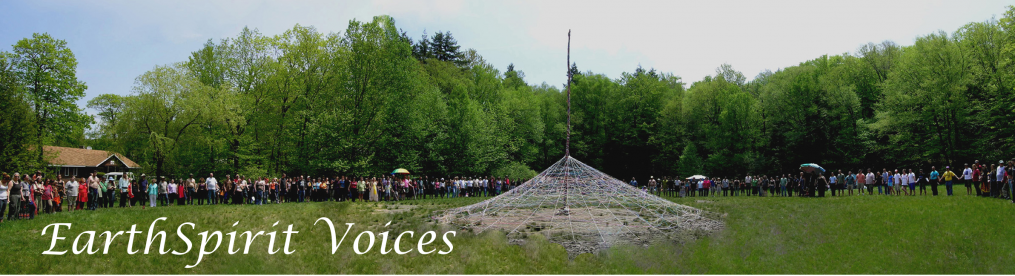
At the Rites of Spring “Weaving the Web of Community” ritual, every year we attach cotton rope strands to the already erected maypole to create a circular warp, held for the community by specific members, into which we then each weave ourselves with our own individual balls of colorful yarn. This year the underlying theme for Rites of Spring was “Creating Community, Changing the World” – a concept at the heart of EarthSpirit’s mission – and at our web weaving ritual we wanted to emphasize this.

5 community members stepped into the center of the circle of several hundred gathered around the maypole and held up the rope stands in pairs – one named for a way that we create our community and the other named for a way that the same work can serve to change the world. People were invited to come forward and take a strand if it called to them, and to hold it for the community to weave itself into, indicating their commitment to that aspect of our ritual intention. As each strand was called, our hearts swelled as several people came forward to hold each one, sometimes 6 or 7 at a time so that, by the time that all were called, fully half of those gathered were in clumps holding the strands that speak so strongly to our values.

Here are the intentions we wove into that web:

We create community by teaching our children that their voices matter.
We change the world by raising young people who know their voices matter.

We create community by creating spaces where all are welcome.
We change the world by advocating for inclusivity where we go.

We create community by working together to care for the mountain we’re on.
We change the world by caring for the lands we come from

We create community by taking the risk to teach each other what we know.
We change the world by cultivating experienced teachers.

We create community by coming together for handfastings, funerals, and other rites of passage.
We change the world by offering meaningful models for others creating rituals for themselves

We create community by singing together.
We change the world by bringing out the music in others.

We create community by offering healing and support during difficult times.
We change the world by offering support to people struggling with disaster or oppression.

We create community by celebrating seasonal cycles together.
We change the world by taking action to protect the natural world.

We create community by cooking for each other.
We change the world by knowing the value of service.

We create community by believing in each other’s capacity to change and grow.
We change the world by striving to offer an alternative model to the punitive justice system.

We create community by offering time and money to sustain our community.
We change the world by enabling our community to engage in global outreach.

We create community by laughing and having fun together.
We change the world by nourishing our spirits, enabling us to do important work in the world.

We create community by holding each other accountable.
We change the world by holding our political leaders accountable.

We create community by supporting each other in caring for our dead and dying.
We change the world by destigmatizing death and honoring it as sacred.

We create community by experiencing the sacred together.
We change the world by engaging in interfaith work.

We create community by creating and sustaining deep connections with each other.
We change the world by showing that enduring relationships are possible.

We create community by honoring our ancestors.
We change the world by striving to become ancestors worthy of honor.

We create community by hiring our friends and by serving our friends.
We change the world by putting our money where our values are.

We create community by caring for each other’s children.
We change the world by debunking the myth of independence.

We create community by creating shared culture that honors all beings.
We change the world by rewriting the mainstream narrative – that any one being or person should be valued more than another.

photo by Hattie Adastra
When the Wind Blows, They Dance

When the Wind Blows, They Dance

by Arianna Knapp

Deirdre held up a tent stake wrapped in white cord and said, “Who will hold a strand for the Trees? The Green Ones among us?” It was May of 2017 and we were at the Community Web Ritual. I turned to Dag’r, looked in his eyes and said “I have to go.” Then I ran across the circle  and sensed a blur of floppy sun hats, sunburned shoulders, and giant parasols as I took the stake from Deirdre’s hands.

As I held the stake, tied to the strand, connected to the Maypole being woven with the songs and energy of my friends, family, and community, there was a simple “knowing.” I had taken the first step on a journey and I had no idea why, or where it would lead. 

In the weeks and months that followed the pledge faded in and out of focus. What did it mean to “hold a strand”? In the Fall of 2017, I attended my first Twilight Covening and then I stepped into the Anamanta journey and I realized a growing drive to be deeper among the beings of the land. I opened to the trees, I gave space in my meditation for green ones, and it brought peace.

While enjoying a rambling mid-Winter drive, Dag’r and I discovered a homestead among the hemlocks, and so we moved. As we introduced ourselves to the land and beings of the land, it was the green ones who taught us, and they continue every day. Open to the wind rolling down the hill, echoing the sounds of waves crashing to the land; open to the creak and groan of Summer breezes, the crack and snap of the coldest clearest night as the trees keep watch. 

As planning for the next Rites of Spring and Village Builders gathering started, there was Deirdre looking at a sea of faces and said “Does anyone feel called to lead the Green Ones Grove?” My hand shot in the air and I found a new way to hold that strand for my community. 

This moment, like that sunny day on the ritual field, is remarkable because I was not making a choice to volunteer. I was not “going to the next level.” I was not acting on information from my methodical, logical, well-planned brain. I simply knew that I would do it, and it was right.

There was a pandemic. We stayed home among the Hemlocks. After weeks had passed and it was clear that normalcy was going to be a ways off, I began to hang out with the trees. The Azalia outside my bedroom door is my confidant. The crabapple with the birdfeeder is a friend. The Hemlocks are my elders, my ancestors, and my guides. The green ones of our land are the Tall Lords and Ladies, and when the wind blows they dance.

As the World opened back up and we gathered again, my shape had changed. I am stronger now, yet more willing to bend. I can see the many shades of the long horizon and I choose to watch the light shift instead of chasing the Sun. My roots are not holding me back, they feed me. 

Being in people-centric spaces has become a chore. When I must spend time in concrete covered lands, I seek the green ones who may be found in planters, on desk tops, or stoically anchoring sidewalks. Breathe with and touch the tree, hug the tree, open to the experience of the tree. 

Last Fall I was appointed the official Tree Warden of Chester, Vermont. This is one among other political roles I fill, but it brings me deep joy. In this capacity, I have now spearheaded a grant process that has garnered funds to replant trees on a riverbank prone to flooding, and to begin to return shade trees to our Main Street corridor. 

I took a strand and pledged to hold it without knowing what it could mean. It has changed me.

-Arianna Knapp
EarthSpirit Board of Directors

photographs © Arianna Knapp

Lunasdal 2023

Lunasdal 2023

by Chris LaFond

Lunasdal always feels to me like one of the most community focused celebrations of the year. Though my heart always longs for the deep, quiet, cold of winter, there’s no denying the appeal of a food festival. And the best time to do that is when the food is ripe!

This ancient festival, observed by ancient Celts and other peoples of northern Europe, celebrates the first fruits of the season. Obviously, in New England, we have harvested a lot before this season: leafy greens, peas, radishes, fiddle heads, roots, asparagus, and so forth. But it’s now, as the summer turns from its height and begins to wane, that we gather the foods that will nourish us through the fall and winter months ahead.

Food & Community

Wheat and grains come into harvest season in late July, as well as fruits and vegetables that are appropriate for preservation: zucchini, tomatoes, squashes, corn, and so forth. This is what we celebrate as we gather to mark the turning of the season once again.

The community aspect of Lunasdal is also of prime importance. As with many indigenous communities throughout the world, the light half of the year is when the Celtic tribes would come together for all sorts of business. Of course, this would vary from place to place, but often this was a time for tribal members to intermarry, cementing political alliances outside of the tribe and strengthening the stability of the region.

Games and competitions were another common practice. These “pagan olympics” can still be perceived in modern day highland festivals which feature competitions and feats of strength.

2023

About fifty members of EarthSpirit and guests gathered at Glenwood Farm on the first weekend of August to celebrate the season. We observed the transformation of the Green Man into a baked loaf; we made offerings to the Stones in the stone circle; the children presented seeds, roots, and leaves as a reminder of the many levels that go into growing the food that nourishes us.

Following the ritual, we shared of our own first harvests and enjoyed the perfect summer day.

Yule Book Flood

Yule Book Flood

Katie LaFond

Editor’s Note: Katie LaFond began the Jolabokaflod tradition for the EarthSpirit Community in the middle of the Covid-19 pandemic — when most of us were isolating and unable to see each other in person — as a way of connecting as community. She wrote this two years ago, but just recently submitted for publication. This is the third year (2022) that Katie has run an EarthSpirit Jolabokaflod. 2022’s Book Flood is underway! If you haven’t had a chance to participate and are interested in it for next year, watch the EarthSpirit Facebook Group and Page for information and sign up right around Samhain.


December 2020

This year was unlike any other, so I shared one of my family’s traditions with the community, in the hopes that it brought some joy to your homes.

Jolabokaflod (Yule Book Flood) started in Iceland during World War II, a time of rationing for many people. Paper was one of the few things that wasn’t rationed, so people gave each other books. Today, the tradition as I understand it, is that people give each other gift-wrapped books and on Christmas Eve they stay up all night reading them and eating chocolate. This is definitely a tradition I can get behind. If you’re interested in learning more about the Icelandic tradition, there are many wonderful resources available.

My ancestry is from all over, but the grandparent I was closest to (and who survived long enough for me to have deep conversations with) was Scandinavian. While my family identifies as American, I have always been fond of Scandinavian traditions, and they’ve made my winter seasons so much happier and fulfilling living in the Hills of Western Massachusetts.

I’m a fan of traditions and have built many with my young family. We have a prayer we say at each meal, we have an annual Dumb Supper at Samhain, and we love Jolabokaflod. Simply put, we give each other books on Yule eve and sit by the woodstove in our jammies, eating chocolate and reading them late into the night. We wake up in puppy piles, kindle a Yule fire, and sing up the sun eating cinnamon buns and drinking spiced coffee.

This year it was my pleasure to extend our tradition to all of you. We each found a book in our homes that we had read and enjoyed and were ready to send on to someone else who might enjoy it. We signed up with a google form, I organized an exchange, and sent out names, addresses, and genre requests to each person. Despite some shipping delays, most people ended up with a book to tuck into, with a mug of hot chocolate perhaps, and a quiet evening of enjoying a good book.

Here are the books that we sent each other this year, in alphabetical order. 

Title. Author (genre, if listed)

  • Assassin’s Apprentice. Robin Hobb (fantasy)
  • Beggars in Spain. Nancy Kress (sci fi)
  • Blink. Malcolm Gladwell (nonfiction/science)
  • Blood Heir (Kate Daniels series). Ilona Andrews (fantasy/romance)
  • Braiding Sweetgrass. Robin Wall Kimmerer (nonfiction/spiritual)
  • Caste: the origins of Our Discontents. Isabel Wilkerson (non fiction)
  • Chronicles of Chrestomanci Volume I. Diana Wynne Jones (fantasy)
  • Code Talker. Chester Nez
  • Do What You Want: the story of Bad Religion. Jim Ruland (non fiction/memoir)
  • Dreamblood: The Killing Moon. N.K. Jemisin (fantasy)
  • Dreamblood: The Shadowed Sun. N.K. Jemisin (fantasy)
  • Fledgling.Sharon Lee and Steve Miller
  • Flesh and Fire. Laura Anne Gilman (fantasy)
  • Free Play. Stephen Nachmanovitch (nonfiction/art)
  • Hex Appeal. PN Elrod (anthology)
  • How To Be ultra Spiritual. JP Sears (comedy)
  • Howl’s Moving Castle. Diana Wynne Jones (fantasy)
  • Love the World. Todd Parr (board book for ages 0-3)
  • Mind of the Raven. Bernd Heinrich (science)
  • Minecraft Dungeons: The Rise of the Arch-Illager. Matt Forbeck (young adult/fan fic)
  • My Abuelita. Tony Johnson (kids book)
  • Norse Mythology According to Uncle Einar. Jane Sibley (comedy, Norse mythology)
  • Pagan Consent Culture. Edited by Christine Hoff Kraemer and Yvonne Aburrow (non fiction)
  • Press Here. Herve Tullet (board book for ages 0-3)
  • Prodigal Summer. Barbara Kingsolver
  • Quarantine and Constellations. Katie LaFond (kindle book, memoir)
  • Rosemary and Rue. Seanan McGuire (fantasy)
  • Songs of the Seven Gelfling Clans. J.M. Lee (fantasy)
  • The Buried Giant. Kazuo Ishiguro
  • The Cosmic Serpent: DNA and the Origins of Knowledge. Jeremy Narby, Ph.D. (nonfiction/science)
  • The Divine Thunderbolt. Jane Sibley (nonfiction/spiritual)
  • The Hammer of the Smith. Jane Sibley (historical fiction)
  • The Lies of Locke Lamora. Scott Lunch (fantasy)
  • The Long Lasting Love of Lady and Lord: The Bonding. Darrell A Roberts
  • The Murder of Roger Ackroyd. Agatha Christie (Mystery)
  • The Mystery of Mercy Close. Marian Keyes (mystery)
  • The Night Circus. Erin Morgenstern (fantasy)
  • The Night Fairy. Laura Amy Schmitz (children’s fantasy)
  • The Rakess. Scarlet Peckham (romance)
  • The Shortest Day. Susan Cooper (picture book/poetry)
  • The Way of the Wise. Jane Sibley (nonfiction/spiritual)
  • The Wishing Spell. Chris Colfer (fantasy)
  • The Word for World is Forest. Ursula K Le Guin
  • Tigana. Guy Gavriel Kay (fantasy)
  • Trace: memory, history, race and the American landscape. Lauret Savoy (memoir/travelogue/science)
  • Twelfth Night. Shakespeare (drama)
  • Wild. Cheryl Strayed (non-fiction memoir, semi-spiritual)

Public Rites, Private Work

Andrew B. Watt

In my first career as a schoolteacher with a speciality in world history, I was often tasked with making the deep past relevant to a modern audience. In my current, second career as an astrologer and artist, I find that this is still in a sense my real job — finding ways to make ancient insights and wisdom available to a modern readership. This is the first of what I hope will be a regular series.

When modern people engage with ritual in an Earth-centered spirituality, it may not be the case that they are explicitly pagan — that is, they may not worship a pantheon of pagan gods with names like Zeus and Aphrodite, Odin and Thor and Frigga. Some of them certainly do; some of them are quite open about it. Others may follow a Christian path, attending a local church in their home community on Sundays. Some may light Shabbat candles, keeping with Jewish family traditions of worship at home.

At Rites of Spring and other events connected with Earth-centered spirituality, though, they will often engage in public rituals in which no god or gods are mentioned by name by the presiding officers. There are things that are said at these rituals, of course — the names of the recently deceased may be read solemnly, or the names of newlywed couples may be announced with joy. There are things that are done at these rituals, too — attendees may dance around a fire to the sound of drumming; or they may erect a Maypole; or take a walk in the woods to connect with nature. Finally, there are things shown: a loud figure in startling garments and grotesque make-up may stand between two smoking torches, terrifying all who hear her; veiled figures may appear at a meal with everyone present, to chaperone a select few off on pre-arranged journeys.

This formula, of Things Said, Things Done, and Things Shown, is very ancient — we know that this was the standard formula of the secret Mysteries of Eleusis in Greece. Candidates for the initiation process underwent a purification rite in mid-March, and then in mid-September of the following year, they all went into the initiation hall at dusk to spend the night in complete darkness. Nothing was said of what occurred in this hall on penalty of death. The Mystai, as the initiates were called, were only able to say, “Well… Things were said, and things were done, and things were shown.”

The ten days prior the Autumnal Equinox are about when these September Mysteries were celebrated — a season that begins this year on September 12. It’s a good time to reflect on one of the essential parts of the EarthSpirit Community’s traditions — that in our public rites, things are said, done and shown — but the meaning of these things is rarely defined for us as members. It remains the private task of the individual and their trusted family and friends, to sort out how what’s said, done, and shown, affects our personal lives — ethically, morally, intellectually, emotionally.

Proserpina with Ceres and Triptolemus
Proserpina with Ceres and Triptolemus, Ancient Greek, circa 330 BCE, Eleusis Archaeological Museum

Many community members call that highly personal and private process, Work—first reflecting on how the public parts of the ritual resonate deeply within us; and second, figuring out how to turn those internal meanings into outward behaviors and actions. Work is an active intellectual, emotional, and creative process. No two members of the community do their Work in quite the same way, either — but you can observe their Work in what they say, what they do, and what they show.

Under Stars,
Andrew B. Watt
Astrologer & Artist
http://andrewbwatt.com/

Beltaine Blessings

This past Sunday ushered in the month of Beltaine (or Bealtaine, as it’s spelled on modern Irish calendars), and for the first time in a long while, we gathered in person at Glenwood Farm, EarthSpirit’s home in Western MA, to celebrate. More than 70 people joined us for the Sacred Land Walk and the Beltaine ritual. The day was glorious and warm, and we visited shrines, danced a Maypole ritual, sang, and shared food and conversation.

But not before burning away Old Man Winter. Kate Richardson led us by eulogizing the old codger, and then burned his effigy in the ritual fire. We share her eulogy with you here, and wish you the brightest of Beltaine Blessings!

Kate and Old Man Winter (photo by Deirdre Pulgram Arthen)

Eulogy for Old Man Winter 2022

We’re gathered here for a joyful occasion: to welcome the spring and the summer to come. But before we can do that with our whole beings, we have to dispose of the Winter that has passed. The old man that was Winter stands here before us in effigy, and we should take a moment to remember him before we dispatch him. As he burns away he can take with him any ill luck and bad feelings from the past season, leaving us free to celebrate what’s to come.
Each year between Samhain and Yule a new Winter is born. We welcome him with feasting and songs, gathering with friends and family to remind ourselves of the bonds of community which will keep us safe and warm through the hard and cold times. As this Winter drove us indoors, he still kept company with the pestilence of the last two years. Although the Rona seems now more ubiquitous but less deadly, it managed to sow discord, anxiety, illness and distress. We were reminded more than ever to take care of each other, even if that meant keeping a distance.
As the Winter reached maturity, going from Yule to Imbolc, he showed off his strength by biting the extremities of hopeful apple tree wassailers, and casting snow in the way of gatherings. And yet, for folk who can enjoy the outdoors, there was snow enough for skiing, and ice enough for ice fishing, as is right and proper for our climate.
Waning in strength after Imbolc, and on to the Vernal Equinox, he still maintained an imposing presence. But there were cracks in his mansion when warmer weather peeked a toe, a finger, a nose, through for just a moment. Winter gripped tight but the trees knew, the birds knew, that his end was coming. The sap flowed sweet, as it is supposed to. The snow and ice melted in the sunny places.
Finally, after Equinox, he came into his dotage, a cranky and unkempt being. The mud season he bequeathed us was the stuff of legends. He petulantly threw late-season frosts and snowfalls our way.
But now we declare that he is well and truly gone. Any lingering chills will be in his memory, and not from his presence. But let us not forget the lessons of Winter:

★ That we must turn to each other to get through the reign of tyrants with hope intact.
★ That we have strength and resilience, fed by songs and stories, by gathering and breaking bread together.
★ That we can get through tough conditions if we plan and prepare, and help each other out.
★ That kindness matters, and can counteract the cold.
★ That there can be great beauty in difficult conditions.

What lessons and blessings has the Winter brought to you?

All that said, we are properly glad to see him gone. He was cold and nasty, and we are ready for the warm and growing times. We may mock him for the bully and codger that he was, for he is gone, and we are all still here to see this turn to the warm times. Go ahead and make fun of him; this effigy will carry the bad words and feelings away. Then we will sing and dance our way to the tide of returning life, taking our place in the turning of the season’s wheel.

Kate Richardson, Beltaine 2022

On Election Day

by Deirdre Pulgram Arthen

Today is Election Day. The country is painfully divided and the weeks following this election are likely to be very challenging, with the potential for violence, disruption and great uncertainty. Some of our community members will be especially vulnerable – people of color, queer and trans folks, immigrants, and those who live in locations where they are surrounded by hate.

The COVID pandemic is also growing and we will probably be spending our winter physically separated from one another as we try to maintain our health and the health of the ones we love. 

Many of us are experiencing legitimate rage and fear, and it can feel like there is nothing tethering us to sanity, normalcy, or security. When we find there are fissures in the ground beneath our feet we need to remember what we know at our core.

Here is what I know:

Community is more important now than ever.
Showing up for each other is more important now than ever.
More than ever, we need to maintain the vision of the world that we want and do everything we can to live in a way that embodies that vision. 

Yes, It is hard to stay focused.
Yes, it can feel hopeless at times.
Yes, it is hard to take a deep breath and step in again.

But we have the resources of a broader community to turn to. We are not separate from the rest of the natural world, and those beings are part of our community too. They do not know politics or COVID and they can help us keep our balance if we spend time with them.

We have the humans that we love who can listen to us and surround us with care.

And we have the mystery, which we can touch but cannot see, and which winds around humans and rocks and streams and birds and clouds and mammals and fire and all the rest to create the world that we view with wonder. We need to remember to look with wonder.
If you haven’t already, I urge you to vote – for the Earth, for Black lives, for kindness, for the things that matter most to you. Vote for what moves us closer to that world we want for future generations.

Tomorrow night is a time to care for yourself. You might choose to be with others on Zoom, you might spend the night in ritual, you might just turn off the internet and read a novel, or anything else.  Wednesday will come and there will be plenty of work to do after that – whatever the results.

I hope that you will find moments of beauty and joy for yourself through this turmoil and I hope that EarthSpirit will be able to contribute to your sense of connection and community. I know that I rely on this community to keep me tethered to what matters. Thank you for being a part of that. 

May there be peace among all beings.