EarthSpirit at the Salt Lake City Parliament

Indigenous women light the sacred fire at sunrise to start the 2015 Parliament of the World's Religions

Indigenous women light the sacred fire at sunrise to start the 2015 Parliament of the World’s Religions

by Eric Arthen

Many people from around the country and around the world have descended on Salt Lake City to attend the sixth Parliament of the World’s Religions [http://www.parliamentofreligions.org/parliament/salt-lake-2015], being held here from October 15 – 19.

Sixteen members of EarthSpirit are taking part in the Parliament (PWR), presenting programs, helping to make events happen, or staffing an information booth to tell participants about EarthSpirit and about the pagan traditions.

This takes a great deal of time and effort from many more members of EarthSpirit than just those who are going on the trip. We are so grateful for the support our whole community has given to make this happen. In particular, the funds we’ve raised over the past couple of years has made it possible for us to participate and send our delegation to the Parliament. All of those who are going are volunteers, and are paying for the trip out their own pockets, but the donations we have received certainly help to defray some of the expenses. We couldn’t do it without you!

You can follow along with both general news about PWR and more specific news about the EarthSpirit delegation on social media outlets. Posts on Twitter will use hashtags #2015parliament and #earthspiritcommunity. On Facebook, check “The EarthSpirit Community” page,
https://www.facebook.com/The-EarthSpirit-Community-119744788098439/
There will also be posts here on the EarthSpirit Voices blog (https://earthspiritvoices.wordpress.com), both during and after the PWR.

Here is the list of presentations in which EarthSpirit members are taking part. The overall number of pagan programs far surpasses anything that the PWR has included in the past:

Friday, 8:30 AM (Mountain time)
Shared Session: Diversity and Applied Theology in Contemporary Paganism
Moderator: Andras Corban-Arthen (EarthSpirit)
Subsession: Diversity in Contemporary Paganism
Panelists: Jeanine De Oya, Eblis Correllian
Subsession: Contemporary Paganism and Applied Theology
Presenter: Dr. Gwendolyn Reece
Panelists: Jim Dickinson, Ivo Dominguez, Jr, Drake Spaeth (Earth Traditions)

Friday, 12:15 PM
Women’s Rites – Honoring and Celebrating the Cycles of our Lives
Presenter: Deirdre Pulgram Arthen (EarthSpirit)
Panelists: Angie Buchanan (Earth Traditions), Isobel Arthen (EarthSpirit), Ruth Barrett (Temple of Diana, Inc.)

Friday, 12:15 PM
People of the Earth: The Surviving Indigenous Spiritual Traditions of Europe
Presenters: Andras Corban-Arthen (EarthSpirit). Inija Trinkūnienė (Romuva)

Friday, 7:00 PM
Plenary 2: Spotlight on Emerging Leaders
A number of speakers including: Isobel Arthen, Donovan Arthen (EarthSpirit)
Performers: Honey and the Sting, Taiko Drummers

Saturday, 7:00 AM
Devotional Chanting for the Earth
Speaker: Deirdre Pulgram Arthen (EarthSpirit)

Saturday, 3:30 PM
We Are the Earth: Pagans Respond to Pope Francis on the Environment
Moderator: Sylvia Hall Linton (Earth Traditions)
Panelists: Andras Corban-Arthen (EarthSpirit), John Halstead (Humanistic Paganism), Heather Greene (The Wild Hunt)

Sunday, 10:00 AM
Ancient Teacher: The Earth As Our Spiritual Guide
Moderator: Angie Buchanan (Earth Traditions)
Panelists: Andras Corban-Arthen (EarthSpirit), Ellen Bernstein (Rabbi, Hampshire College), Elizabeth Weigel, Ajisebo Ogunninhun Abimbola

Sunday, 1:45 PM
Sons and Lovers of the Sacred Feminine
Presenter: Drake Spaeth (Earth Traditions)
Panelists: River Higginbotham, Ivo Dominguez, Jr, Donovan Arthen (EarthSpirit) , Claudiney Prieto

Monday, 7:00 AM
Understanding Religious Traditions 101 – Paganism
Panelists: Andras Corban-Arthen (EarthSpirit), Angie Buchanan (Earth Traditions) , Donald Frew (Covenant of the Goddess), Ruth Barrett (Temple of Diana, Inc.), Starhawk (Earth Activist Training)

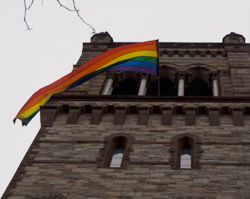
Pride Interfaith Service

Pride Interfaith Service

Our cloutie tree

Our cloutie tree

At the beginning of 2013, after two years of EarthSpirit’s participation in the annual Pride Interfaith Service, I joined the organizing group, the Pride Interfaith Coalition, as a representative of EarthSpirit.  The group began meeting in January to plan this year’s service, which took place on June 8.

One of the great strengths of the Coalition is that it is made up of people who unite around central shared concerns.  As I said in my welcome on behalf of the Coalition during the service,

We join together with the common purpose of doing two things.  First, as human beings, as people of faith, and as leaders of religious or spiritual traditions, we want to affirm, support, and celebrate you as members and allies of queer communities.  And second, we affirm that the sacred, in the wide variety of ways that we understand and perceive it, not only accepts but embraces all of who you are.

Coalition members include representatives from queer-affirming organizations within traditions from Buddhism to Judaism to Catholicism. Because EarthSpirit, like most contemporary pagan groups, has always been queer-affirming, our membership in the Coalition felt like a natural step to me.  This year, I was delighted to be able to part of reshaping the format of the service so that it was more organically connected to our intentions and to the specific traditions of Pride, rather than borrowing from a single religious tradition.

I was also delighted to bring one of our tradition to the service: a cloutie tree that we prepared where attendees could share their wishes, blessings, and prayers for the Pride community.

As we planned this service, we thought a great deal about the creative tension between each of us as an individual and our collective and communal identities, and one thing that came out of that is the blessing tree that many of you tied wishes or prayers on to before the service.  The idea of tying blessings or prayers onto trees has a long history: in ancient Ireland, people used to rip strips from the hems of their shirts and tie them on to trees near wells and other sacred sites to ask for help, healing, or blessings.  The idea has been passed down through folk customs and has been adopted in my pagan tradition.

I was thrilled to meet some of the pagans in attendance at the service this year.  For next year, we’ve already started talking about organizing a pagan contingent to march in the parade!  Please do reach out if you’re interested in being involved in these efforts.  In the meantime, I’d love to hear about how queerness and paganism connect for you.

Thank you all for helping

by Deirdre Pulgram Arthen

It has been another busy year for EarthSpirit, as we have consolidated and expanded our important work in all branches of activity — thanks, in large part, to many dedicated community members who have made contributions of their time, expertise, goods and funds to support the work of the organization. We are very grateful; we could not do it all without you.

In over thirty years of existence, EarthSpirit has been able to grow into one of the largest pagan organizations in the US, supporting its members with programs and actively engaging in the world on many levels to create change. We’ve done a lot, and we look forward to doing more.

One of the original intentions of EarthSpirit was to build spiritual community through connections. Over the years this has always meant local and regional celebrations and gatherings, publications, performances and classes. By offering programs and leading rituals for other organizations, we build relationships regionally and around the country. Increasingly, EarthSpirit has reached out to its international members to assist in developing community in Europe and Central and South America. We hope to further develop and deepen these efforts in the coming year.

Our web site, www.earthspirit.com, continues to be an entry-point for newcomers as well as a resource for long-time members. Our recent addition of EarthSpirit Voices (earthspiritcommunity.blogspot.com) has brought sharing and discussion of spiritual practice into our presence on the Web. We look forward to expanding and improving both of these important communication vehicles in the near future.

In the early 1980s we realized that pagans, given the opportunity, could make meaningful contributions to the interfaith dialogues that were developing both nationally and globally, and that we could also benefit greatly from participation in such forums. Since that time, EarthSpirit has played a major role in helping paganism attain a much greater level of credibility and respect within the interreligious movement. The work that EarthSpirit director, Andras Corban Arthen, has been doing through his service on the board of trustees of the Council for a Parliament of the World’s Religions (CPWR) has been growing. Last November, Andras was sent by the CPWR to Guadalajara, Mexico, as part of the site committee which evaluated that city’s bid to host the 2014 Parliament. While there, he also had the opportunity to meet with many local pagans as well as several indigenous leaders.

In February, Andras went to Chicago to help choose the host city for the 2014 Parliament, which will be Brussels, Belgium. In early May, he was sent back to Guadalajara along with CPWR executive director Dirk Ficca to explore ways to maintain a working relationship with the local group that organized that city’s bid, including a collaboration to develop an interreligious initiative throughout Latin America. As a result of that trip, Andras was asked to serve as the CPWR’s liaison with the Guadalajara group. In addition, Andras was elected again to the CPWR’s executive committee, and was asked to oversee the Parliament’s Ambassadors program, which coordinates several hundred Parliament supporters from all over the world.

The ‘Indians’ of Old Europe, the presentation that Andras has been offering in recent years which places the surviving pagan traditions in the context of Indigenous European spirituality, has been receiving a great deal of favorable attention throughout the interfaith movement, with lots of people telling him how it’s helped them to see paganism in a different light and to take it much more seriously. As a result, he has been receiving many invitations to speak at interfaith and academic events in the U.S. and abroad, including two next year in India and Denmark. Unfortunately, those invitations rarely cover all of the expenses involved, so the only way he is able to attend is through the support and generosity of our community.

EarthSpirit has been committed to young people since the outset. Without engaging and including youth, any community becomes unsustainable. Our mentoring programs, Rites of Passage ceremonies and ongoing activities such as EarthSpirit PeaceJam help those growing up within our community learn from the experience of elders while finding their own voices and means of expression. In the coming year we look forward to continuing and expanding our support for these programs.

In 2011, thanks to our generous donors, we have replaced our sluggish and undependable office computers with new Dells that actually work reliably. What a difference it makes for our office volunteers! We have also begun work to completely revamp our database system using expert volunteers to develop and create a configuration that will greatly improve our ability to stay connected with members across the US and around the world.

As you might imagine, all of this work, in so many areas, requires a significant amount of money to sustain it. Despite the struggling economy over the past few years, our community has been very generous. We have consistently received contributions large and small — both in the mail and at the auction at Rites of Spring. We appreciate every single one. Please consider increasing your donation to EarthSpirit this year to help us move quickly toward our goals.

We count on you to be a part of the web that holds us together on so many levels. Thank you all for helping EarthSpirit to continue moving forward!

Deirdre Pulgram Arthen, Executive Director

Boston Gay Pride Interfaith Service

by Deirdre Pulgram Arthen

This weekend I was invited to participate in the Boston Gay Pride Interfaith Service. It took place at the Old South Church in Copley Square right before the parade on Saturday morning. It was wonderful to be a part of what turned out to be an inspiring service on many levels and I was heartily welcomed into the group of clergy which included Buddhist, Protestant, Jewish, Catholic, Muslim and Yoruba representation — in addition to the Pagan. I look forward to having the opportunity soon to connect more closely with the organizing committee for this service and, perhaps, to finding some EarthSpirit members who would like to coordinate an EarthSpirit presence at Pride events around the state next year.

My part of the service was the “Call to Worship” which happens at the beginning of a Christian service as a transition into the focused spiritual part of the service after the welcoming remarks and announcements. The theme of the entire Pride week celebration was “no more and no less.” Here is the text of my remarks:
Good morning,
We come together to begin this very festive day with a moment of reflection on, and celebration of, our personal connections with spirit, We do this here in a community of others for whom that spiritual connection is also an important part of life. Look around you and see the diversity of who we are here – We come from many backgrounds, from many spiritual traditions, we have different temperaments, different lifestyles and different perspectives. But at the root of it all, what we share in common is our humanity and, through that, our own special place in the web of creation.

In that web of life are the trees, the stars, the rocks, the rivers, the birds, the grasses on the plains, the thundering waves of the ocean, the insects in your garden, the deer and the coyotes in the forest, the mist rising at dawn. What wonder we can know when we open and experience the majesty of each of these! And what wonder can we know when we see that we are, each of us, no more and no less than any of these beautiful and powerful aspects of creation. That we are the earth itself.

Many people are inclined, I think, to choose to see themselves as separate from the world, to create an “us and them” divide that either values humans as the owners of a world where everything is created especially for our own use, or to denigrate our role to that of a cancer – eating away at our fragile eco-system and destroying our home.

While it is undoubtedly true that we humans have extraordinary capacities to create and to destroy, and that with that capacity comes an obligation to be conscious of our actions and take responsibility for them, as long as we keep viewing ourselves separate from the web we will not know how to keep it intact. We will not know the depth of the ways that our tugging on one strand affects the rest.

My experience has been that when I am able to let go of my assumptions, to allow myself to move away from my rational, judgmental brain and into my heart and spirit – to find that place in this sacred web where I belong, that place where I am one with the very soul of the Earth and the sky and all the beings in them, I can touch the mystery I am a part of, and find direction and peace.
I invite you to join me now in a call and response to open ourselves deeply to the sacred of which we are a part – no more, and no less than any other. My daughter, Isobel, will sing the response part with you – the words are simply “I am the Earth”

We then sang my chant “I am the Earth” together as a call and response.

(I was followed by a Muslim woman who read a scripture from the Koran and then by a Yoruba practitioner who led us all in a drum blessing.)

[Photos by Moira Ashleigh]

A Call for Solidarity on 9/11

from the Board of Trustees
Council for a Parliament of the World’s Religions

As the anniversary of 9/11 approaches, there are competing views about the meaning of these tragic events.

Across the interreligious movement, there is deep distress about the intentions of some to identify the Muslim tradition, and the Muslim community, as the villains, rather than a few radical individuals. Unfortunately, too many in the United States know little about the true aims of Islam, nor do they know that Islam is fundamentally a religion of peace and human solidarity and that the majority of Muslims around the world are peace-loving citizens who unequivocally condemn terrorism in the name of religion.

Regrettably, recent opposition to the building of mosques and community centers in several cities has led to violence against Muslims and the desecration of their sacred texts. Burning that which others hold sacred is an act calculated to spark anger and fuel violence. We believe that such actions are unworthy of our nation and stand outside the shared values of our traditions which call for mutual respect and harmony.

Trustees of the Council for a Parliament of the World’s Religions call upon people of faith, spirit and goodwill from all traditions to use the solemn occasion of this 9/11 anniversary to reaffirm our commitment to building a better world for our children and grandchildren, and to affirm our solidarity with the Muslim community in this country and around the world.

In this spirit, we offer this Call for Solidarity:

On this 9/11 weekend, we invite all persons and communities of faith, spirit and goodwill everywhere to lift up their prayers, voices and thoughts to spark a new attitude and sense of urgency, and to enkindle a different flame:

  • a spark that will ignite in us again the impetus to bring comfort to those who lost loved ones on that terror-filled day, and in the violent conflicts and wars that followed from it;
  • a spark that will ignite in us again to stand calmly and firmly against the forces of violence, distrust, hostility and cruelty;
  • a spark that will ignite in us again to stand with those who find themselves on the margins of our society – the homeless and those losing their homes, the documented and undocumented immigrant, the unemployed and financially insecure;
  • a spark that will ignite in us again the commitment to seek healing and reconciliation at home and abroad, in the cause of justice and peace.

In whatever ways that are in keeping with our individual and unique sacred traditions, we issue a call to stand together this weekend of September 10 – 12 in order to quench the fires of hatred and violence in our nation and our world, and to become aflame for the cause of a truly “beloved community.”

The Board of Trustees
Council for a Parliament of the World’s Religions

Report on Current Travels in Europe

by Andras Corban Arthen

During last December’s Parliament of the World’s Religions in Melbourne, Jonas Trinkunas ­­— the head of the Romuva pagan religion of Lithuania, whom I had invited to attend the Parliament as one of the Indigenous speakers — reciprocated by inviting me to speak at a Congress of European Ethnic Religions which he had founded a dozen years previously, and which was to be held in August in Bologna, Italy. Jonas also very kindly invited me to participate in a Romuva camp which would take place in the Lithuanian countryside about two weeks before the Congress.

I consulted with the EarthSpirit Board, and everyone thought it would be important for me to attend these events; after checking the books, we found that there were enough funds in the interfaith budget to finance the trip.

Then, this past spring, Kusumita Pedersen — a friend and colleague on the Parliament’s Board of Trustees — told me of some people she had met while participating in the annual United Nations Permanent Forum on Indigenous Issues in New York. Kusumita said they ran an NGO based in Torino (Turin) which consults with the U.N. on Indigenous concerns, and that as part of one of their presentations which she attended, they talked a great deal about the Indigenous European traditions (“they sounded just like you,” she told me). This raised some interesting possibilities, given that I was already planning to attend the Congress in Bologna. Later on, while talking with my old friend Phyllis Curott, who has taught in Italy several times, she suggested that I should meet some of her friends and students there, and kindly put me in touch with them.

So, little by little, my trip has taken shape: Boston to Dublin, to do research for a couple of days at Trinity College. Then on to Vilnius and several days at the Romuva camp out in the country, followed by a return to Vilnius to testify on Romuva’s behalf with the Deputy Mayor for cultural affairs in their effort to secure government support for office/meeting space in the city. Then off to Copenhagen for a one-day stop to do some research at the Nationalmuseet. From there a brief stop in Milan, followed by a train ride to Torino to meet with the heads of the Ecospirituality Foundation. Then a train to Rome and a meeting with local pagans, and, finally, the conference in Bologna before returning home.

I am in Europe now (in Bologna, to be precise), though it’s very difficult to write more extensively on EarthSpirit Voices from here, given that I’m not staying in any one place very long and that it’s sometimes difficult to find good and accessible Internet connections. I will be publishing a full report of my activities here as soon as I am able, though it may have to wait until I’m back in the States.

The Revival of the European Indigenous Pagan Religions

by Andras Corban-Arthen

As it has been previously noted in these pages, within the global interreligious movement that has evolved since the first Parliament of the World’s Religions was held in Chicago, pagans have typically been placed in the category of New Religious Movements, which roughly applies to religions that have emerged since the middle of the 19th century. This would seem to be, surely, the most appropriate category for the neopagan and reconstructionist groups that make up the greater part of modern paganism, since their existence does not appear to go further back than the early 1950s.

For thirty-some years, however, I have been trying to make the case throughout the interfaith movement that some forms of paganism — namely, the very few remaining survivals of ethnic European spiritual traditions — more properly belong in the category of Indigenous Religions. My arguments, and others’ similar arguments, have mostly fallen on deaf ears — both pagan and non-pagan alike — for various reasons which make it a lot more convenient for many people to believe that no such survivals exist at all.

For Christians, for example, an acknowledgment that the original pagan traditions were not completely wiped out opens the door to the unpleasant possibility that they may, finally, have to deal with the genocidal horrors which Christianity inflicted on Indigenous peoples throughout the world. Outside of Europe, the blame for such heinous acts — when they are even acknowledged — has conveniently been attributed to chiefly secular motives, such as excessive nationalistic ambitions and economic greed, which obscure their actual, fundamental aim and rationale. When the Christian colonization of Europe is factored in, however, it becomes a lot harder to camouflage the theologically-justified goal of creating a vast religious empire, which continued to be the foundation for most subsequent Christian European colonization elsewhere. But if no trace of the original European pagan traditions were to survive, the motivation to open that painful door becomes less compelling, and the comforting obliviousness of the status quo can remain untouched.

For many Native Americans, the prospect of the continued existence of Indigenous European traditions is often met with decidedly mixed feelings. On the one hand, the survival of some of those traditions after more than fifteen-hundred years of Christian colonization could be taken as a hopeful sign for their own survival, not to mention the new allies they are likely to gain among the keepers of such practices. On the other hand, Native Americans have had so much taken from them by White people that a lot of them can understandably react with suspicion and even resentment in the face of such a prospect, especially if it can, in any way, take some of the focus away from their own struggles to preserve what is left of their cultures.

And, ironically, many neopagans themselves are extremely resistant to the notion that ethnic forms of European paganism have survived into the present. For them, this raises fears of delegitimization, of marginalization, of power trips: given the contentious history of the modern pagan movement, this reaction is not very surprising.

Be that as it may, after all the years of trying to convince people in the interfaith movement, last December in Melbourne, for the first time ever, the Parliament of the World’s Religions finally included the surviving European ethnic spiritual traditions in the same category as other Indigenous religions from around the world, a very significant step which could pave the way to many interesting possibilities.

As I mentioned in an earlier article, when given the task of organizing the European components for the Parliament’s Indigenous Task Force programs, I invited krivis Jonas Trinkunas, the head of the traditional Romuva pagan religion of Lithuania, to be one of the featured speakers. Lithuania was one of the last European countries to be Christianized, and its history and cultural makeup have combined in a way that has allowed paganism to survive there to a degree that may be unsurpassed anywhere else in Europe. In Melbourne, Jonas and I offered a presentation together, entitled “The Revival of the European Indigenous Pagan Religions,” which was meant to address some of the various key elements in the survival of Indigenous European spirituality.


Jonas, along with his son-in-law Artūras Sinkeviĉius, opened the program by singing a Lithuanian daina, one of several thousand traditional folksongs from their homeland that are imbued with mystical and religious meanings. Jonas discussed the role of the dainas in ethnic Lithuanian paganism, as the most important vehicle for spiritual transmission across the generations. He then went on to talk about the history of Romuva, and about the various factors that enabled Lithuanian paganism to survive into the modern era — preserved clandestinely or disguised as “folklore” — despite intense opposition and suppression by both the Catholic Church and the Soviet Union.

I spoke then about the traditional practices from the Gàidhealtachd (the Gaelic-speaking culture of Scotland) which I received from my teachers back in the late 1960s; of my eventual realization that such practices represented the rare survival of a very old, non-Christian form of spirituality; and of my subsequent search, both in Europe and throughout the European diaspora, for similar surviving traditions.

Then Jonas and I took turns describing some of the commonalities that are found among most of the European traditions, as well as some of the important differences, particularly between Eastern and Western Europe (rural focus, preservation of old tongues, animistic vs. polytheistic approaches, etc.) Our presentation was very well received, and was cited in a very good article on the Parliament which appeared in the Summer 2010 issue of Parabola magazine.

There’s obviously a whole lot more that could be said about all this, though EarthSpirit Voices is probably not the best format through which to convey it. I have now presented a two-hour talk/slide show/film entitled “The ‘Indians’ of Old Europe” several times in the last couple of years, and it looks like I will be turning it into a book. I am also planning a series of trips to various parts of Europe to meet with keepers of surviving Indigenous traditions, though when and where that happens will depend on what kind of funding we are able to raise for the purpose.

I hope that the door which we managed to crack open at the Melbourne Parliament will gradually widen and that the surviving Indigenous pagan religions of Europe will finally be able to shed their mantle of invisibility, not only as a way to insure their continued existence, but also because of the particular wisdom, values and perspectives which they are able to impart.

[ Ed.note: Andras will be offering his talk on The “Indians” of Old Europe on Sunday, September 12 as part of The EarthSpirit Community’s “Sacred Lands” Open Houses at Glenwood Farm in Western Mass. For more information, go to http://www.earthspirit.com/openhouse/index.html ]

Indigenous Peoples’ Statement to the World

An Indigenous Peoples’ Statement to the World Delivered at The Parliament of the World’s Religions Convened at Melbourne, Australia on the Traditional Lands of the Wurundjeri People of the Kulin Nation December 9, 2009

The Doctrine of Christian Discovery  and Indigenous Peoples (l. to r.) Christopher Peters, Jake Swamp,  Oren Lyons, Steven Newcomb

        The Doctrine of Christian Discovery
                and Indigenous Peoples
   (l. to r.) Christopher Peters, Jake Swamp,
        Oren Lyons, Steven Newcomb

In keeping with the theme of this year’s Parliament, “Make a World of Difference: Hearing each other, Healing the Earth,” we, the Indigenous Peoples participating in this Parliament, hereby issue this statement:

We are Indigenous Peoples and Nations who honor our ancestors and care for our future generations by preserving our lands and cultures. For thousands of years, Indigenous peoples have maintained a fundamental and sacred relationship with Mother Earth. As peoples of the land, we declare our inherent rights to our present and continuing survival within our sacred homelands and territories throughout the world;

We commend the Australian government’s recent support for the United Nations Declaration on the Rights of Indigenous Peoples adopted on September 13, 2007. We call on all governments to support and implement the provisions of the UN Declaration, particularly the right of self-determination;

Since time immemorial we have lived in keeping with our sacred laws, principles, and spiritual values, given by the Creator. Our ways of life are based on thousands of years of accumulated ecological knowledge, a great respect for our Mother Earth, a reverence and respect for all our Natural World relations and the survival of our languages, cultures, and traditions;

The Indigenous instructions of sharing and the responsibility of leadership to future generations are wise and enduring. As the traditional nations of our lands, we affirm the right to educate our children in our Earth-based education systems in order to maintain our Indigenous knowledge systems and cultures. These have also contributed to our spiritual, physical and mental health;

Indigenous peoples’ concept of health and survival is holistic, collective and individual. It encompasses the spiritual, the intellectual, the physical and the emotional. Expressions of culture relevant to health and survival of Indigenous Peoples include relationships, families, and kinship, social institutions, traditional laws, music, dances, songs and songlines, reindeer and caribou, ceremonies and dreamtime, our ritual performances and practices, games, sports, language, mythologies, names, lands, sea, water, every life forms, and all documented forms and aspects of culture, including burial and sacred sites, human genetic materials, ancestral remains so often stolen, and our artifacts;

Unfortunately, certain doctrines have been threatening to the survival of our cultures, our languages, and our peoples, and devastating to our ways of life. These are found in particular colonizing documents such as the Inter Caetera papal bull of 1493, which called for the subjugation of non-Christian nations and peoples and “the propagation of the Christian empire.” This is the root of the Doctrine of Christian Discovery that is still interwoven into laws and policies today that must be changed. The principles of subjugation contained in this and other such documents, and in the religious texts and documents of other religions, have been and continue to be destructive to our ways of life (religions), cultures, and the survival of our Indigenous nations and peoples. This oppressive tradition is what led to the boarding schools, the residential schools, and the Stolen Generations, resulting in the trauma of Indigenous peoples being cut off from their languages and cultures, resulting in language death and loss of family integrity from the actions of churches and governments. We call on those churches and governments to put as much time, effort, energy and money into assisting with the revitalization of our languages and cultures as they put into attempting to destroy them;

The doctrines of colonization and dominion have laid the groundwork for contemporary problems of racism and dispossession. These problems include the industrial processes of resource exploitation and extraction by governments and corporations that have consistently meant the use of imposed laws to force the removal of Indigenous peoples from our traditional territories, and to desecrate and destroy our sacred sites and places. The result is a great depletion of biodiversity and the loss of our traditional ways of life, as well as the depletion and contamination of the waters of Mother Earth from mining and colonization. Such policies and practices do not take into account that water is the first law of life and a gift from the Creator for all beings. Clean, healthy, safe, and free water is necessary for the continuity and well being of all living things. The commercialization and poisoning of water is a crime against life;

The negative ethics of contemporary society, discovery, conquest, dominion, exploitation, extraction, and industrialization, have brought us to today’s crisis of global warming. Climate change is now our most urgent issue and affecting the lives of Indigenous peoples at an alarming rate. Many of our people’s lives are in crisis due to the rapid global warming. The ice melt in the north and rapid sea rise continue to accelerate, and the time for action is brief. The Earth’s resources are finite and the present global consumption levels are unsustainable and continue to affect our peoples and all peoples. Therefore, we join the other members of the Parliament in calling for prompt, immediate, and effective action at Copenhagen to combat climate change;

In July 2009, the Episcopal Church in the United States adopted a resolution at its 76th General Convention, repudiating and disavowing the dehumanizing Doctrine of Christian Discovery. By doing so, the Church took particular note of the charter issued by King Henry VII of England to John Cabot and his sons, which authorized the colonizing of North America. It was by this ‘boss over’ tradition of Christian discovery that the British crown eventually laid claim to the traditional territories of the Aboriginal nations of the continent now called Australia, under terra nullius and terra nullus. This step by the Episcopal Church was an act of conscience and moral leadership by one of the world’s major religions. Religious bodies of Quakers and Unitarians have taken similar supportive actions.

In conclusion, we appeal to all people of conscience to join with us in support of the following issues:

1) Climate change and its far-reaching impacts on our Peoples and homelands — for this we need immediate action.

2) The protection of Indigenous peoples’ significant and sacred sites within their traditional homelands and territories and working to eradicate discrimination and intolerance against Earth-based Indigenous spiritual and ceremonial traditions.

3) Protection of Sacred Places used for prayer and ceremonies. At these special places we minister to the Earth and heal her sacred soul.

4) The critical need to strengthen and continue our unique cultures and languages, particularly by bringing together elder cultural and wisdom keepers and Indigenous youth.

5) The return of the bones of our ancestors and our sacred items.

6) The immediate support and implementation of the United Nations Declaration on the Rights of Indigenous Peoples.

7) To call upon Pope Benedict XVI and the Vatican to publicly acknowledge and repudiate the papal decrees that legitimized the original activities that have evolved into the dehumanizing Doctrine of Christian Discovery and dominion in laws and policies.

Partial list of Indigenous Assembly participants:

  • Wande Abimbola, Yoruba (Nigeria)
  • Omie Baldwin, Diné (United States)
  • Nana Osei Boakye Yiadom, Adamorobe (Ghana)
  • Merekaraka Caesar, Wahine Maori (New Zealand)
  • Andras Corban-Arthen, Anamanta (Spain/United States)
  • Ryoko Foose, Ainu (Japan)
  • Tonya Gonnella Frichner, Onondaga (United States)
  • Uncle Max Harrison, Yuin (Australia)
  • Linda Hogan, Chickasaw (United States)
  • Robert Houndohome Hounon, Vodun Hwendo (Benin)
  • Clarence Jackson, Tlingit (United States)
  • Jennie R. Joe, Diné (United States)
  • Mandaza Kandemwa, Shona (Zimbabwe)
  • Norma Kassi, Vuntut Gwich’in (Canada)
  • Leo Killsback, Cheyenne (United States)
  • Tsugio Kuzuno, Ainu (Japan)
  • Margaret Lokawua, Karimjong (Uganda)
  • Oren Lyons, Onondaga (United States)
  • Raúl Mamani, Kolla (Argentina)
  • Ray Minniecon, Kabi Kabi (Australia)
  • Lucy Mulenkei, Maasai (Kenya)
  • Joy Murphy Wandin, Wurundjeri (Australia)
  • Minnie Naylor, Inupiaq Eskimo (United States)
  • Steven T. Newcomb, Shawnee Lenape (United States)
  • Francois Paulette, Dene (Canada)
  • Christopher Peters, Pohlik-lah/Karuk (United States)
  • Anna Pinto, Meitei (India)
  • Constantino Pinto, Timorese (Timor Leste)
  • Uncle Bob Randall, Yankunytjatjara (Australia)
  • Darlene St. Clair, Bdewakantunwan Dakota (United States)
  • Artūras Sinkevičius, Romuva (Lithuania)
  • Joseph Henry Suina, Cochiti Pueblo (United States)
  • Jake Swamp, Akwesasne Mohawk (United States)
  • Yoland Trevino, Maya (Guatemala/United States)
  • Jonas Trinkunas, Romuva (Lithuania)
  • Rosita Worl, Tlingit (United States)
Delivering the Indigenous Statement at the closing plenary.

Delivering the Indigenous Statement at the closing plenary.

The Parliament’s Indigenous Assembly Part II: Who is "Indigenous"?

by Andras Corban Arthen

The Indigenous Assembly (and, indeed, the Parliament’s entire Indigenous program) was a success in that it met most of the goals we had set out to accomplish, particularly so in bringing together and fostering connections among a diverse international group of tradition keepers, elders and activists. But the very process of organizing such a program also brought to the fore some volatile, contentious issues that are inherent to the very concept of indigeneity, and which marred the sense of harmonious cohesion we had envisioned at the outset.

The term “Indigenous” is used in both interreligious and academic circles with a fairly specific meaning: it refers to cultures and to peoples that have had a very distinctive, long-standing historical and cultural connection with a particular land. A practical yardstick often applied to this definition is whether a given culture pre-existed, and has survived, a major colonizing event such as Christianization/Westernization.

As with any definition, the meaning of “Indigenous” is easiest to express when we give it a very specific and narrow focus. When, for instance, the term is applied exclusively to people who have been born and raised in a specifically defined geographical region and within a particular Indigenous culture, fit a certain racial/ethnic profile, speak the traditional language, practice the traditional religion, and have deep roots in the community that maintains the Indigenous culture alive, then if a person meets those criteria obviously and fully, there should be no question about his or her claim to indigeneity.

Of course, defining the term in such a specific way automatically excludes a lot of people. From a theoretical point of view, that may not matter at all; indeed, it may be desirable. But when we move from the theoretical and the analytical into the realm of actual human experience, the exclusionary quality of such a narrow definition can clash violently against an individual’s or a community’s sense of self-identity, and lead to people becoming quite angry and offended. Moreover, the scope of that exclusion can disenfranchise important claims to indigeneity that don’t necessarily fit neatly within a narrow and clear-cut definition.

For instance, there are Indigenous peoples who have been colonized to the point of losing their traditional spirituality, even though they may still live in their ancestral lands and may have managed to retain other key elements of their ethnic culture, such as language. A case in point was the Sami contingent that participated in the Assembly: there is no question that they are an Indigenous people, and are recognized as such by the U.N., the European Union, and the governments of the various countries wherein they reside. Yet, as I pointed out in an earlier article, it appears that the Sami Indigenous religion is all but dead, and that was certainly borne out by the delegates present at the Assembly – they were all Lutherans and Presbyterians, and none of the ones with whom I spoke professed to have any knowledge of their traditional religion outside of the realm of “folklore.”

In attempting to define “Indigenous,” some members of our Task Force had initially been adamant about not including in our program anyone who was Christian, feeling that the acceptance of Christianity was intrinsically at odds with an event intended to emphasize authentic Indigenous spirituality. They were persuaded to modify their views when it was pointed out that many “authentically Indigenous” people practice both their traditional religion as well as Christianity, and this middle-ground became our guideline. The Sami, being exclusively Christian, presented a dilemma for the Task Force, since they did not fit within our established criteria. (I, for one, was delighted that they were admitted to the Assembly in the end.)

On the other hand, there are Indigenous traditions which have specific procedures for accepting those who were not born and raised within them – procedures (and criteria) which can vary significantly from one tradition to another. This makes it hard to generalize, though typically such mechanisms can involve marriage, formal adoption, relocation or pilgrimages, cultural assimilation, specific training and ceremonies, etc. Once the non-native has been assimilated to the satisfaction of the elders of the community, she or he is generally accepted as a full-fledged member of that tradition, and in some cases can even attain the position of elder, leader, teacher or spokesperson (I know of several Indigenous traditions, for instance, which have official spokespeople who are not individuals born into those cultures, but who have married or been formally adopted into them).

In many (and probably most) Indigenous cultures, allowances of this sort have always been in place, because very few societies have been completely insulated from interaction with others. In some, those allowances have been relaxed or expanded in more recent times out of necessity, particularly among Indigenous traditions that are on the verge of extinction and are therefore more open to the inclusion of “fresh blood,” as it were, in order to preserve their ways. This is a slippery slope, of course, fraught with many possibilities for abuse and scams – one has only to think of the myriad self-anointed “plastic shamans” out there, or the “traditional grandfathers/grandmothers” who use this as a rationale for ostensibly teaching gullible white people in exchange for considerable sums of money. But the fact that the possibility of abuse in these circumstances is very real does not alter the fact that Indigenous peoples often define themselves in ways that are far less rigid or specific than how academics or interreligious bodies would define them.

In a nutshell, then, there are Indigenous people practicing Indigenous spiritual traditions; there are Indigenous people practicing non-Indigenous spiritual traditions; and there are non-Indigenous peoples practicing Indigenous spiritual traditions. Considering that the Indigenous cultures are the oldest remaining ones on the planet, and that many of them are on the brink of extinction, to limit the definition of “Indigenous” only to the first category because it is nice and clear-cut, amounts to turning one’s back on some of the peoples or traditions that are most endangered and in need of support.

Obviously, the Parliament’s Task Force had to adopt certain standards regarding what it considered “Indigenous” in order to select potential speakers for its slate of programs, and as much as possible we tried to choose criteria that were general enough to be applicable to most authentic Indigenous traditions. In my opinion, however, the way some of those standards were actually applied was in some cases very selective or arbitrary, and at times lacking sufficiently clear information to enable us to make well-thought-out choices.

As a member of both the Indigenous Task Force and of the Parliament’s Board of Trustees, it would be inappropriate for me to air our “dirty laundry” in public. But the way the Task Force conducted its process led to a number of problems, and several people who were very upset at the way they were treated complained about it directly to me; in my opinion, their feelings were quite justified.

For instance, some North American Indians who had proposed programs for the Parliament complained of being ignored or dismissed, and felt that they had been judged – by people who didn’t know them at all – as not being “Indian enough” despite having dedicated their lives to the welfare of their native communities, or to the protection of their civil rights, or the promotion of understanding and respect of Indian cultures by the mainstream society.

On the other hand, representatives of Central and South American Indigenous traditions complained to me, both during and after the Parliament, about their lack of inclusion at the event. Indeed, the Task Force invited only one Indigenous speaker from South America (and none from Central America) who, as it turned out, was unable to attend in the end for personal reasons. There would have been no representation at all from those regions at the Indigenous Assembly had it not been for Raúl Mamani (a Kolla Indian from Argentina) and Yoland Trevino (a Mayan from Guatemala, who resides in the U.S.) – both of whom were attending the Parliament under the auspices of the United Religious Initiative (URI), and managed to gain admittance to the Assembly at the last minute. (Rachael Watcher, an old pagan friend who is affiliated both with the URI and Covenant of the Goddess, also attended the Assembly as Raúl’s translator.)

But that was not nearly enough, and word of this unfortunate situation has clearly spread to one degree or another throughout Latin American interfaith circles and Indigenous rights groups, and I have fielded the questions and complaints of friends from México to Chile. Some of them see the Parliament – and interreligious events in general – as the exclusive playground of wealthy white people who may pay lip service to issues of economic and social justice, but, in the end, make little effort to actually include dark-skinned people from impoverished societies.

A couple of them were even more specific in their grievances, and claimed that, in addition to the above, there is also a very noticeable prejudice on the part of certain North American Indian peoples toward their counterparts south of the border. They allege that some Indians from the U.S., in particular, seem to treat Indigenous peoples from Latin America with the same dismissive attitude with which they are themselves treated by many white people in this country. And, as regards the international interreligious community, they assert that North American Indians – generally being not only better off economically than those from Central and South America, but also better connected by having the advantage of speaking English – exert a disproportionately greater influence at interfaith events than the poorer, non-English-speaking Indians from Central and South America. To underscore this claim they pointed out that, of the invited Indigenous speakers listed on the Parliament’s website, fully half were from North America alone, despite the fact that the Parliament was held more than seven thousand miles away from that continent.

I am not really in a position to be able to gauge how accurate or widespread these troubling allegations may be – if anything, I would like to hope they are not much more than the result of momentarily hurt feelings over a perceived injustice, rather than widely held, long-simmering resentments. Regardless, it is clearly important that the various people involved in this process be mindful that, to one extent or another, such feelings exist.

On another front, several of the Indigenous representatives at the Assembly also noted with surprise the lack of Maori participation – given the relative proximity of Australia and New Zealand – and the fact that the only Maori delegate present, Merekaraka Caesar, actually lives in Queensland, Australia. This led some to wonder if perhaps there might be prejudice and discrimination on the part of some of the Australian Aboriginal peoples toward the Maoris. I have been assured by those who should know that this is not the case; nevertheless, the noticeable absence of a significant Indigenous community created further speculation and tension at the Assembly.

There were other complaints involving the Task Force – ranging from rudeness to racism – which bear reckoning, though I won’t go into them here, as this is already much too long. The main lesson to be learned here, it would seem, is that when it comes to interacting with Indigenous peoples – who, historically, have surely endured the evils of occupation, slavery, racism, poverty, cultural destruction and genocide the longest – organizations like the Parliament must exercise a very high degree of awareness, of sensitivity and of diplomacy, even when their motives are good and their goal is to help. The suffering many of these people have felt, and continue to feel, can intensify what most of us might brush off as nothing more than a petty slight, and turn it into a deeply painful wound.

For people who are desperately seeking aid in their struggle to save their homes and their ancestral lands, exclusion – even if it is only perceived exclusion – easily translates into hopelessness. For people who’ve had the prejudices of a foreign race forced upon them for hundreds of years, the imposed standards of outsiders, no matter how well-intentioned or intellectually reasoned, only seem like more alien judgments. And for people whose ancient cultures, subjected to attrition, ridicule, and legal proscription, are hanging by very thin and fragile threads, the questioning of their cultural identity can feel like somebody trying to steal their soul.

As the Parliament continues to reach out to Indigenous peoples around the world, it would do well to keep all this in mind.
The Parliament’s Indigenous Assembly Part I: A Gathering of Ancient Ways

by Andras Corban Arthen

One of the most important events of the Parliament of the World’s Religions – the Indigenous Assembly – was, quite likely, the least visible: attendance was by invitation only, and it was held in a former convent several miles away from the Exhibition Center, where most of the other programs took place.

In keeping with one of the Parliament’s seven main themes (and as mentioned in these pages prior to the event), the idea of convening an Indigenous Assembly in Melbourne was, from the beginning, a major focus of the Indigenous Task Force’s plans – we wanted to create a space wherein the international representatives of Indigenous traditions traveling to Melbourne would get a chance to meet with their counterparts from Australia and the South Pacific to discuss issues of mutual relevance, and perhaps even come up with a joint statement to be delivered during one of the Parliament’s plenary sessions. Our initial plans called for a three-day assembly which, for the first two days, would be limited exclusively to the Indigenous delegates, then opened on the third day to include representatives from other cultures and religions. Unfortunately, budgetary and time constraints forced us to scale back our plans and keep the assembly to one day.

Early in the morning of Monday, 7 December, about fifty Indigenous representatives, volunteers and translators traveled to the Abbotsford Convent near Victoria Park, some six miles away. Most of us had already had breakfast, but upon arrival we were offered juice, pastries and other refreshments as we waited for everyone to arrive.

The proceedings started with a brief introduction by Task Force chair Omie Baldwin, followed by a traditional welcome to country by Auntie Joy Murphy Wandin, senior elder of the Wurundjeri people who are the traditional “owners” of the land that includes Melbourne. Wominjeka Wurundjeri Balluk yearmen koondi bik (“welcome to the land of the Wurundjeri People”), she intoned, as she did probably a dozen more times during the course of the Parliament; but each time she spoke those words they were like music, as fresh and as heartfelt as if she were saying them for the very first time, and we felt, indeed, very welcome. Auntie Joy had some very kind words to say to those of us who served on the Task Force and organized the event, and gave each of us an Aboriginal flag as a gift.


Then we went around the room introducing ourselves to each other, and several people, including Chief Jake Swamp (Mohawk) and Wande Abimbola (Yoruba) offered blessings in their traditional languages. They were followed by several speakers who addressed issues of cultural survival, of civil rights, of sovereignty. I was particularly impressed by Steve Newcomb (Shawnee/Lenape), who spoke about his attempts to mount legal challenges to U.S. government policies toward American Indian peoples based on the Christian Doctrine of Discovery, and his campaign to convince the Pope to repeal the Renaissance-era papal bull which provided the rationale for that doctrine.


We then had a relaxed lunch break, which allowed us ample time to lounge in the convent’s courtyard and get to know each other a little more intimately. Besides spending some time with Jonas Trinkunas and Arturas Sinkevicius, my two Lithuanian friends, I had conversations with Robert Houndohome Hounon – the Voudon leader from Benin, whose trip to the Parliament had been partly financed by Angie Buchanan’s pagan community – and with Chris Peters (Yurok), president of the Seventh Generation Fund for Indian Development, who had been our keynote speaker that morning. I also had the opportunity to talk with Uncle Bob Randall and his delightful American wife Barbara (from Connecticut). Bob, who is one of the traditional “owners” of Uluru, was abducted as a child as part of the Stolen Generations, and eventually became one of the foremost activists in bringing an end to that tragic practice. In addition, I was able to chat for a bit with some members of the Sami delegation, mostly from Norway and Sweden.

We eventually returned to the hall for small group discussions on nine key topics which the Task Force had identified: Spirituality, Health, Repatriation, Environment, Water, Mining, Language, Land and Global Warming. I went to the table focused on Spirituality, and joined a group which included the two Lithuanian delegates as well as Yoland Trevino (Maya), Global Council Chair of the United Religious Initiative, and Merekaraka Caesar, (Maori), president of the Universal Peace Federation, who proved to be extremely nice and interesting people.

After some lively conversation, we coalesced into one big group again, to go over what we had discussed and to organize a committee that would synthesize our thoughts into a statement to be shared with those assembled at the closing plenary, and also be sent on to the international representatives who would meet in Copenhagen, right after the Parliament, for the U.N. Climate Change Conference. I will include a copy of the statement following this two-part piece.


We ended the day with a traditional Australian barbecue (yes they had “shrimps on the barbie,” in addition to several other equally tasty items) and a very friendly group photo.