While it is true that as a child I was thrilled by Gene Kelly’s performance in Singing in the Rain, and while he might have inspired my love of the rain early on — this isn’t about that kind of singing in the rain. It’s about sudden storms, and golden light, and daring.
I was driving home, rain was falling, I was semi-miserable from having been bent in half most of the day, and wanted nothing more than to be standing in the rain somewhere not caring about anything else — just me and the rain. We are in a severe drought right now, and a few minutes after the rain started falling it stopped, and I was very sad. The sun broke through the clouds with that particular quality of light that only happens after a brief rain, that glittering with golden light off each raindrop that can stop any other thought when it is beheld. I had a thought then — what if I really did allow that golden warmth/light into my solar plexus? What might happen if I actively chose to work this specific magic? (many of my physiological malfunctions reside there, many of them I was born with).
Well, here’s what happened. A song spontaneously emerged from me — took some singing to clarify the message but it finally landed — and when I sing it, I allow that sunrise/starshine to emerge in and from my solar plexus as a ritual of healing and self-care.
I offer it here to you, sans melody, and invite you to create what melody you will if you desire to bring this sentiment into your life.
Golden sun rising inside of me Golden star shining in spite of me My Lady teach me to Be, to Know and to See When I See me, I behold Thee When I behold Thee, it’s me I See. When I look through me, up to me, the Whole and the true me When I See me, I behold Thee When I behold Thee, it’s me I See
Rose Sinclair August 31, 2022 Waxing moon in Libra
I’ve sung it alone, sung it with others, sung it in a round, sung it as a collective. I find it relatively soothing while also being challenging — a low impact spirit workout, as it were, going to the place I Am Not Strong, but can be stronger.
Each year around Beltaine, some friends of mine from the hilltowns of Massachusetts make an effigy of Old Man Winter. On May Day morning he is ceremonially thrown off a scenic gorge into the rushing water below. Before his departure, I have been for a number of years delivering a eulogy to honor the season’s passing. If Winter were a man who was born around Solstice, reached his prime around Imbolc, waned into his elder years through the Equinox and finally died by Beltane, what kind of a person was he? What did he achieve, bring us, or teach us during his life? Here follows my eulogy for the winter that just passed.
Kate brings Old Man Winter around the circle for a final Good-bye.
Eulogy for Old Man Winter 2025 How shall we remember this Winter now that his time has passed?
I have spoken to so many people who have had hard times and much loss since Winter was born between Samhain and Solstice. In the course of his life, there’s been so much upheaval and anxiety in the world, and so much work that needs doing. In this context the Winter came like a gentleman. He certainly had his own work to do, and he did it, but without an unduly heavy hand. He offered early ice to skate on. Later there was snow for skiing, though not as much as some might wish. I even heard him called a weakling on account of the shortage of good skiing in the hills. But others called him considerate, even cozy. Myself, I wonder if maybe he was a bit depressed, just hanging on and filling out his obligations, waiting out the time till his inevitable end. When it was time to depart, he did so without much fuss. There was one last April snow, but in most places it was more nostalgic than earnest. Big flakes to remind us of the feeling of the early winter’s fat harvest festivals, and the snowpiles were soon gone without the town ever breaking out the plows. Now as spring emerges so do the people, seeking each other and seeking the warmth and the energy to do the work that still needs to be done. The green and the blooms cheer us on as we make our way down Winter’s funeral path. We are reminded that, however sad and dire things may be, life will go on. We must acknowledge the hardships, but we should also celebrate the joys. Let us look to each other and see that we are still standing, while Old Man Winter has fallen, as all tyrants eventually must fall. Tie your sorrows to his withered corpse, and heave them away; make room for the hope and promise of renewal. Hail the Spring!
This moment in US history is extremely hard for me to fathom. As the child of a Holocaust survivor, I have been feeling triggered over and over, especially, most recently, by the abductions and disappearances. I consider “Christian Nationalism” and I feel the terror personally, while at the same time I feel angry and resent this administration using “smokescreen antisemitism” as a justification for some of these actions, as a cover for their own racism, Islamophobia and actual antisemitism.
Over the past six weeks I have also been meeting with a group of committed pagans from across the US most of whom have once, or currently lead groups, many of them older teachers and organizers, like me, with some younger people as well who are in leadership roles in their own communities. We are trying to find ways to build a network that can help hold all kinds of pagans in this time of crisis. Even as we struggle with the shape of what we hope to create, it is good to see these friends in the Zoom windows and know that we are struggling together.
At a time like this it is important not to be alone. When I find myself sliding and wanting to retreat into isolation and fear, I know that it is time to reach out. It is time to get together with a friend for lunch or for a walk, time to gather and sing with my spiritual community, even time to try to wade through social media to see who is there that I can wave to. Rites of Spring planning sessions enliven me. Working together with others and with a shared purpose in service of community is fuel for my heart.
Community matters at a time like this. We are stronger when we are together, when we can hold each other up and keep each other from breaking. Community can energize us to keep standing and moving forward, to not give up. A spiritual community, like EarthSpirit, can help us find strength in our practices, our shared beliefs and experiences, our shared rituals and our songs. When we come together anytime to sing of what is sacred, or celebrate the return of spring, we can open our hearts and let some light in, let some joy in, let some love in! And now, at this dangerous time, finding ways to be together, especially in person, can be healing. Holding hands, joining voices, marching in resistance, being together in the name of what is life-affirming and good and sacred, knowing there are others next to you who feel as you do, who care for you and care about your well-being, these can lift some of the load that we each carry.
Try it — find your people and gather. I think you will be glad that you did.
A story from the Visioning Ritual at Twilight Covening 2024
Once, in the world between, there came a time of great trouble — so great that it felt to the people like their world was disappearing. They tried to listen and talk with one another, but somehow the languages they spoke were no longer understood by their neighbors. They tried to find peaceful solutions to conflict, but the violence around them expanded. They tried to find ways to care for their world, but it continued to become more barren. They felt powerless and angry, lost and afraid.
Over generations, during times of struggle the people had always relied on a well of sacred water which held power. But they had drawn power from their sacred well so often in recent times, that even it was beginning to dry up.
Faced with an ever depleting source of power, the people held a council to find a way forward. They considered rationing what water was left, they considered giving power only to the leaders to use as they thought best, they considered using only the power needed to survive, and turning away from the struggling world. They could not agree on what was most important. Finally, the oldest person in the village spoke and reminded the people that in earlier times of struggle their ancestors had journeyed to find new sources of power when their well was so depleted. The people agreed that the one thing left for them to do was to learn from those ancestors and embark on a similar journey themselves.
No one had taken that journey in generations. They knew that it would be long and might be dangerous. They didn’t know the way. They knew from legend that they must begin by honoring their ancestors and then find their way to the Witch’s hut in the forest, but they didn’t know who else they might meet along the path. As afraid as they were about this journey, they were more afraid for the state of their world. And so, driven by their own desire to protect the things most precious to them, they set forth, each carrying a vessel of power drawn from the dwindling sacred well, to use as they needed it. A long journey began.
First they traveled to honor their ancestors. They stopped at the shrine to listen to whispers on the wind, telling where those gone before them had found sources of power and the uses they had put it to. Then, inspired to continue, the travelers moved further into the woods where they soon came to the Witch’s hut, as they expected. There they encountered the old Witch, who bade them consider the source of their personal power and stirred their words into her cauldron. As they went on, they met other beings who taught them vital lessons about finding and using power. They experienced the wonder of the world and used some of their power to add beauty to it. They learned the importance of using power in service of others — or receiving from others when they needed it. Then they met a challenge that required all that they had. For some, it was more than they were prepared to give, but despite that, they continued forward — walking with emptiness for a long time.
At last they were welcomed into a place of connection, with nature and with community, where they were renewed enough that they could imagine once again having the ability to give or receive.
When they had reached that point of openness, they discovered that they could reshape themselves and create a completely new vessel for holding power. And then they learned how to find the power that could fill that new vessel — both from within, and from connection with infinite mystery — and that they could decide when and how to use that newly found power.
When the people returned to the village they saw that with the power that each of them now carried they could refill their collective well and get ready to face the problems around them. And they now also knew that as long as they kept finding ways to replenish their own power, they would have enough to sustain themselves, to support each other, and to make changes to improve their world.
Editor’s Note: This book was released November 2024, and was edited by Deirdre Pulgram-Arthen, the executive director of the EarthSpirit Community. To order the book directly from the publisher, please use the link at the bottom of this post.
NORTHFIELD, MA—NatureCulture announces the release of our 20th publication, The Black River: Death Poems. This is an anthology of poems about death and dying, available in two versions: portable paperback with owl cover for people who are grieving, and all-black large format hardcover for use by death ritual leaders. 69 authors from eight countries have contributed to this anthology of 149 poems grouped into four stages: Dying, Death, Remaining, and Journeying. The poems are heavily indexed: by relationship to deceased; by themes—memory loss, pregnancy loss, long/short illness, violence/war/suicide, hope, acceptance of death; by language—most are English and there are 3 in Spanish, 1 French, and 1 Arabic; and by suggested for use in ritual. This book is non-denominational and brings together contemporary poets writing on the many stages of grief and death. 250+ pages; featuring interior page decorations by artist Martin Bridge.
The editor, Deirdre Pulgram-Arthen, has worked in service to her local, spiritual, and interfaith communities for 40 years. She has a graduate degree in counseling psychology, is a certified Death Midwife, and a published author and composer of sacred chants. She is a mother and a grandmother, which is her favorite title. Deirdre lives in the Berkshire hills of western Massachusetts with a small community on a 130 acre nature preserve. Deirdre believes that “By using music and poetry to reach beyond rational thought and touch the depths of our felt experience, the arts serve as passageways for transformation and healing.” She has a passion for creating deeply spiritual, personal experiences of the sacred—in recognition of ourselves as a part of the natural world, and as a way of expanding our connections within the human community. As the director of EarthSpirit, a non-profit focused on current and traditional European earth-centered spiritualities, Deirdre creates rituals for celebration, seasonal cycles and rites of passage—including the sacred passage into death.
In keeping with NatureCulture’s mission to help people be in right relationship with the rest of Nature, this book addresses human existance within physical and spiritual relationships in the physical world and beyond. Publisher Lis McLoughlin believes “Poetry has an essential role to play in helping people come to terms with complexity, and the dying process, death itself, and the subsequent experiences of people who love the deceased, are among the most complex experiences humans encounter.”
The book is organized in such a way as to try to address feelings that arise at any stage of grief or grieving, without being prescriptive or simplifying, and includes a section directly related to Our Animal Kin. It adds powerful contemporary poetic voices to the conversation about, and rituals pertaining to death. The poets offer their experiences and insights so that no one will have to rely on an internet search for a one-size-fits-all classic poem, but rather, can choose something more personally meaningful.
A book launch with panel discussion and poetry reading was held November 3, 2024, online. The book can be ordered from your favorite bookstore. To order the book directly from the publisher: https://www.nature-culture.net/the-black-river-death-poems
I’ve been reading one of Father Greg Boyle’s books. G, as he is called, works with gang members, young people whose entire mindset is centered on violence and group identity. He shares stories about times that he got angry, frustrated, shaking his fist at the sky, and helplessness — not knowing what to do next. I was thinking about his stories and also about conversations I had with Dolores Huerta, a community organizer who has taught hundreds about meaningful equity and how to make meaningful change. These two people have what appears from the outside to be an unlimited energy, an insurmountable drive. But the truth is that they are just as human and subject to the emotional fallout of the actions of the world as the rest of us.
I remember one year during the 2016 election cycle, Dolores came to the university where I worked at the time. She was leading one of her famous get-out-the-vote tours and had come to rally our young adults. This civil rights icon could have filled the stadium for her rally, but she had been assigned a relatively small auditorium in the back area of the student union and the crowd spilled out into the hallways and central balcony area as people crammed shoulder to shoulder to hear this tiny force of nature. She and I found ourselves quietly waiting in a back hallway, listening to the crowd, for her entrance. “Can I ask you something, please, Dolores?” “Of course.” “My students talk about burnout,” I said, with tears unexplainedly starting to rise. “They ask how we keep going. I don’t know what to say. It’s so hard sometimes. Everything is just… so hard. And it just keeps going. How do you keep going? What do I say to them?” I asked as I tried not to let my own emotions rise to the surface. She paused, turned her body towards me fully and looked up at me with the deep compassion of a mother who has raised children and an activist who has rallied cities. She took my hand and patted it. “I see what has happened,” she said. “Your country has broken your heart.” I was stunned. We stared at each other for a heartbeat. “Don’t worry. It won’t be the last time. So get angry. Scream and stomp your feet. Have your pity party — that’s ok. …Then get your ass up, brush it off and get back to work.”
I recently had the opportunity to visit the foundation that she started with her daughters in California. They live and work in the same place where Dolores led grape worker strikes all those years ago, now a deeply “red” political district, kept that way by redistricting every time power from the people rises too far. I met vecinos (community members) who had learned English to be able to testify about poisoned water, youth who had led a campaign to install sidewalks near schools, middle schoolers who led get-out-the-vote campaigns; and I walked with Dolores and her daughter Camila in the field where she had first taken up a megaphone. We talked about “just doing the next thing,” and how there was always something else — sometimes small, sometimes enormous, but always equally important to the people in the way. The work was not just about clean water, vaccines, and voting, but also about swimming pools and soccer fields — places to find joy and fun. Equity and community are not just about keeping hate at bay — they are also about building good lives for people.
At the end of the day, after a full agenda of business meetings, walking tours, and photo ops, we were leaving from dinner. Dolores turned to me and Liz, who was going to give us rides home, and asked “hey- do you want to go see some jazz?” Liz and I looked at each other. “Jazz?,” we asked, “really? I mean, it’s been a long day.” “There’s this group that gets together every Tuesday night to jam, and tonight there are some students that I know sitting in. It’s on a patio — great space. Want to go? I mean, if you’re too tired, I understand. The times zones and all…” Liz and I agreed and we headed to jazz night. We got drinks at the bar — Dolores asked for the good tequila — sat near the back, and we had a thoroughly lovely time for a few hours. I asked Dolores how often she came and she told me “as often as I can. You have to do fun things and this is soo good.” As we got up to leave, a group of women across the room noticed her as the crowd parted and came rushing over, asking for photos and autographs. Now nearly 10pm on a Tuesday night, Liz and I looked at each other, wondering if we needed to help her escape, but Dolores moved towards them without an ounce of hesitation. I watched as she shook each hand, made eye contact and asked “Hello! What’s your name and what do you do for your community?”
What a profound and simple question — what do you do for your community? And not just that — name yourself and take credit for what you do. Don’t seek out recognition, but don’t shy away from it either. As she spoke to every person who came up to her, a growing line as we watched, she greeted every person equally and without an ounce of hesitation. I watched from just behind her right shoulder. I saw genuine curiosity, and a knowingness that her question prompted something important that immediately told people what was important to her. And every response — every response, no matter how seemingly insignificant — was validated with a smile and encouragement.
There is something central and important here about how we do things and what we choose to do. The call to action is to do something. Anything. It actually doesn’t matter how small, because lots of small things add up to big things. Everyone doing something moves us in a direction, and we can see each other in how we relate to and support one another. Our differences are there, but so are our relationships, and those relationships give us common ground. Sometimes it’s just an inch of common ground, but it’s there.
The other important lesson from Father G and Dolores is to do things that make you happy and don’t forget the joy in the world — go see jazz. Be present and enjoy the good tequila. Remember why you fight and what you are fighting for. You have to remember your “why.” There is just so much happening in the world, and while we all take breaks from the news barrage, turning away is not an option. It is easy to feel helpless in the face of so much hatred, death, and destruction. I found myself bolstered by knowing that Father G sometimes feels helpless, sometimes doesn’t know what to say. I found myself reminded that Dolores knows exactly how I feel; she has felt it too. And both know that change is incremental — it’s a long game, sometimes very long, but that the time scale of the world doesn’t always match what we want it to be, and nothing happens if we do nothing. Sometimes we are just doing “the next thing,” the small thing in front of us in our little corner of the world. But we cannot lose sight of our “why.” We cannot lose sight of the impact that we have when we take action, and what is at stake. When you lose sight of that, it’s all just paperwork and responsibility, and it’s heavy and hard. Knowing your “why” doesn’t make it less hard, or less heavy, but it does remind you that you are not alone and that you are not carrying anything by yourself. Community becomes a magic word. So — What do you do for your community? What’s your ”why?”
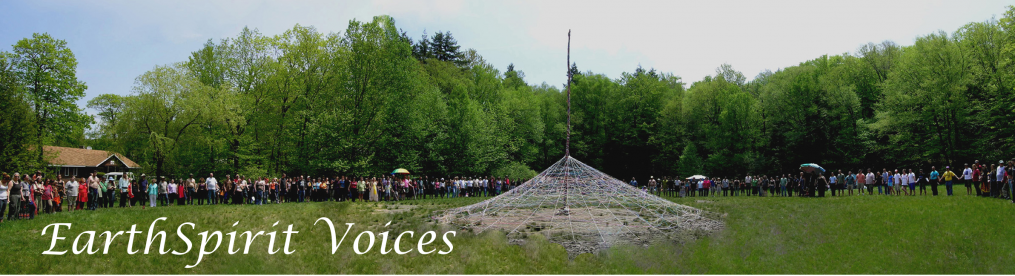
At the Rites of Spring “Weaving the Web of Community” ritual, every year we attach cotton rope strands to the already erected maypole to create a circular warp, held for the community by specific members, into which we then each weave ourselves with our own individual balls of colorful yarn. This year the underlying theme for Rites of Spring was “Creating Community, Changing the World” – a concept at the heart of EarthSpirit’s mission – and at our web weaving ritual we wanted to emphasize this.
5 community members stepped into the center of the circle of several hundred gathered around the maypole and held up the rope stands in pairs – one named for a way that we create our community and the other named for a way that the same work can serve to change the world. People were invited to come forward and take a strand if it called to them, and to hold it for the community to weave itself into, indicating their commitment to that aspect of our ritual intention. As each strand was called, our hearts swelled as several people came forward to hold each one, sometimes 6 or 7 at a time so that, by the time that all were called, fully half of those gathered were in clumps holding the strands that speak so strongly to our values.
Here are the intentions we wove into that web:
We create community by teaching our children that their voices matter. We change the world by raising young people who know their voices matter.
We create community by creating spaces where all are welcome. We change the world by advocating for inclusivity where we go.
We create community by working together to care for the mountain we’re on. We change the world by caring for the lands we come from
We create community by taking the risk to teach each other what we know. We change the world by cultivating experienced teachers.
We create community by coming together for handfastings, funerals, and other rites of passage. We change the world by offering meaningful models for others creating rituals for themselves
We create community by singing together. We change the world by bringing out the music in others.
We create community by offering healing and support during difficult times. We change the world by offering support to people struggling with disaster or oppression.
We create community by celebrating seasonal cycles together. We change the world by taking action to protect the natural world.
We create community by cooking for each other. We change the world by knowing the value of service.
We create community by believing in each other’s capacity to change and grow. We change the world by striving to offer an alternative model to the punitive justice system.
We create community by offering time and money to sustain our community. We change the world by enabling our community to engage in global outreach.
We create community by laughing and having fun together. We change the world by nourishing our spirits, enabling us to do important work in the world.
We create community by holding each other accountable. We change the world by holding our political leaders accountable.
We create community by supporting each other in caring for our dead and dying. We change the world by destigmatizing death and honoring it as sacred.
We create community by experiencing the sacred together. We change the world by engaging in interfaith work.
We create community by creating and sustaining deep connections with each other. We change the world by showing that enduring relationships are possible.
We create community by honoring our ancestors. We change the world by striving to become ancestors worthy of honor.
We create community by hiring our friends and by serving our friends. We change the world by putting our money where our values are.
We create community by caring for each other’s children. We change the world by debunking the myth of independence.
We create community by creating shared culture that honors all beings. We change the world by rewriting the mainstream narrative – that any one being or person should be valued more than another.
Deirdre held up a tent stake wrapped in white cord and said, “Who will hold a strand for the Trees? The Green Ones among us?” It was May of 2017 and we were at the Community Web Ritual. I turned to Dag’r, looked in his eyes and said “I have to go.” Then I ran across the circle and sensed a blur of floppy sun hats, sunburned shoulders, and giant parasols as I took the stake from Deirdre’s hands.
As I held the stake, tied to the strand, connected to the Maypole being woven with the songs and energy of my friends, family, and community, there was a simple “knowing.” I had taken the first step on a journey and I had no idea why, or where it would lead.
In the weeks and months that followed the pledge faded in and out of focus. What did it mean to “hold a strand”? In the Fall of 2017, I attended my first Twilight Covening and then I stepped into the Anamanta journey and I realized a growing drive to be deeper among the beings of the land. I opened to the trees, I gave space in my meditation for green ones, and it brought peace.
While enjoying a rambling mid-Winter drive, Dag’r and I discovered a homestead among the hemlocks, and so we moved. As we introduced ourselves to the land and beings of the land, it was the green ones who taught us, and they continue every day. Open to the wind rolling down the hill, echoing the sounds of waves crashing to the land; open to the creak and groan of Summer breezes, the crack and snap of the coldest clearest night as the trees keep watch.
As planning for the next Rites of Spring and Village Builders gathering started, there was Deirdre looking at a sea of faces and said “Does anyone feel called to lead the Green Ones Grove?” My hand shot in the air and I found a new way to hold that strand for my community.
This moment, like that sunny day on the ritual field, is remarkable because I was not making a choice to volunteer. I was not “going to the next level.” I was not acting on information from my methodical, logical, well-planned brain. I simply knew that I would do it, and it was right.
There was a pandemic. We stayed home among the Hemlocks. After weeks had passed and it was clear that normalcy was going to be a ways off, I began to hang out with the trees. The Azalia outside my bedroom door is my confidant. The crabapple with the birdfeeder is a friend. The Hemlocks are my elders, my ancestors, and my guides. The green ones of our land are the Tall Lords and Ladies, and when the wind blows they dance.
As the World opened back up and we gathered again, my shape had changed. I am stronger now, yet more willing to bend. I can see the many shades of the long horizon and I choose to watch the light shift instead of chasing the Sun. My roots are not holding me back, they feed me.
Being in people-centric spaces has become a chore. When I must spend time in concrete covered lands, I seek the green ones who may be found in planters, on desk tops, or stoically anchoring sidewalks. Breathe with and touch the tree, hug the tree, open to the experience of the tree.
Last Fall I was appointed the official Tree Warden of Chester, Vermont. This is one among other political roles I fill, but it brings me deep joy. In this capacity, I have now spearheaded a grant process that has garnered funds to replant trees on a riverbank prone to flooding, and to begin to return shade trees to our Main Street corridor.
I took a strand and pledged to hold it without knowing what it could mean. It has changed me.
Editor’s note: The zodiac divides the sky into 12 signs of 30º each. An ancient subdivision of these 30º signs is into three “decans” (from the word for “ten”), or 10º segments. Each year, ten days before the Spring Equinox, the Sun reaches the third decan of the sign of Pisces, before beginning the astrological year again as it enters Aries at the Equinox. This post was written specifically for this third decan of Pisces.
This time of year, I find my thoughts drifting back to something my friend Sara Mastros said about visiting Greece in February. She got into a cab one day at her hotel, and told the cab driver to take her to Eleusis, about fourteen miles away. The driver, once he understood her request, nodded and sighed. “There, it will already be spring.” In downtown Athens, she said, this was a hard statement to credit —it was cold and blustery, with an extra needle or two of frost in every breeze. But, once there, she found it impossible to ignore — there was new greenery everywhere, and flowers were starting to open in every sunny sheltered place around the site of the ancient Telasterion, the hall where the Mysteries of Eleusis were celebrated.
It was already spring there.
Of course, the Greater Mysteries of Eleusis were celebrated at the start of the ancient month of Boedromion. Called “The Showing” and open only to initiates, it was a multi-day ritual that we know only a little bit about, and some of that only from Christian apologists attacking it as pagan nonsense. The season of these Mysteries began on the 14th day of Boedromion, and probably at or just before the Autumn Equinox, and with particular pomp and circumstance every four years. We know that these rites involved the story of Hades kidnapping Persephone, of Demeter’s imposition of the first winter on the Earth, and Zeus and Hermes negotiation of a truce.
But by the 7th century BCE, the Mysteries were already so old and full of archaic language that people barely knew what they were witnessing. And sometime in the century or so that saw the elevation of Homer’s Iliad and Odyssey to cultural prominence in Greece, the priestly families that oversaw the Eleusinian rites established the Lesser Mysteries. These lesser mysteries, called “the Teaching” or “The Telling”, were also only open to would-be initiates, who sent a donation of a piglet as an offering to the Telasterion and its attendant families as the price of initiation.
This Telling was held at this time of year, in our mid-March before the Spring Equinox, in the Athenian “month of flowers” — and they were a catechism of sorts, a multi-day series of rituals, sacred meals, purifications, lectures and discussions about what would be received by the initiates at the Greater Mysteries. Once inducted, attendees then were eligible to participate in the Greater Mysteries eighteen months later, where they would have the background and intellectual framework to understand the experiences that the initiates went through in the autumn.
It sounds a lot like a modern pagan gathering, with rituals interspersed with workshops, doesn’t it? And how many of us had the depth of knowledge to understand our first pagan gathering? How many of us needed to come a second time, or a third, to really understand what was going on?
Of course, our rituals today are not the same. At Eleusis in the fall, we know there was “an ear of grain in silence reaped” — there was a mass washing of people at a beach, and a night in complete darkness, and a sacred drink in the dark, and a chest or box with sacred secret things in it, and a basket whose contents are similarly obscure to us today. And our rites and rituals are not so obscure or ancient to us that we have to hold special training sessions eighteen months ahead of time to have clarity about them.
But. All the same?
It’s not a bad idea to use this time of year to reflect on our own mysteries — not the Mysteries of what this object or that ancient text might mean to us as pagans today; or how to interpret the strange symbolism of rituals that haven’t been performed in almost eighteen hundred years.
No — instead, let’s take the time to talk about the Mysteries of how all life on Earth is dependent on the interrelationships of Sun and seed and soil, of rock and planetary orbit and seasonal shifts in daily sunlight, and the way that the dead provide both the fuel and foundation for new life. We can couch it in myth — like Persephone and Hades and Demeter and Helios — or in the most up-to-date scientific lingo we can.
But at its heart, this is still a mystery we humans understand only a little. And we deserve to be reminded of it, again and again — and perhaps most especially at this time of year, when the equinox is not yet come and the trees are still bare of leaf or blossom. This is the time of year when we most benefit from the reminders and the explanation, of course — because in summer and in autumn, the bounty of this transformation is obvious. Now we need to Tell ourselves the story, because the Show will be so obvious, later in the year.
And perhaps this is the reason to mark the Lesser Mysteries now, at this time of year when it’s still gray. It’s how we make spring come early in our hearts and minds, and bring a little of the mystery of Eleusis into our life.
Culture is the context; if it is holding you firmly and comfortably, it is mostly invisible. In my writing, I like to bring these unseen things forward, and try to make them a little easier to feel and to weave into your own context. Today, I’m going to talk about what I (and my family) do in the Dark.
Pagans often talk about the Light half of the year, and the Dark half. Most understand this to mean the time between Beltane (May) and Samhain (November), and Samhain to Beltane. Most understand the Light Time to be a time to come together, to celebrate, to share, and to socialize, and the Dark Time to draw within, to rest, to dream, and to tend the inner fire.
The Light half of the year brings us together at Gatherings, Sacred Land observances, Harvest Festivals, and frequent opportunities to come together. Pagans can mostly be as busy as they want to be during this time of the year, which my extroverted friends delight in, and even my introverted friends appreciate the overt model for “what to do.”
Descent
The first part of the Dark Time follows a fairly predictable pattern, and one we have plenty of models for. At Samhain, many families will clean graves, have a Dumb Supper, and Honor the Ancestors. At Yule, we sing up the Sun, burn a Yule Log, and gather with loved ones.
Then, for a lot of people, it feels like a very long, cold time before Beltane.
We have fewer models for “what to do” as New England pagans. We have Imbolc, which isn’t really the start of spring here, and even Spring Equinox often still feels like winter. We make Brigid crosses and often have our children hunt for eggs amid snowdrifts, but it is too cold to eat all that chocolate outside.
I return to the idea that we draw within, rest, dream, and tend the inner fire. When we lived in close knit communities that relied on each other for survival, we would spend the winter together, gathered around the hearth. We would tell stories, make music, make tools, weapons, art, and clothing. We would tap the trees during sugaring season and take turns tending the boiling sap, watching the billowing water vapor create dragons in the frosty air. We slept more, and dreamt more deeply, telling each other about our dreams, and letting the Unseen be a little closer to us.
In January I Dream. I foster a deep dreaming culture with my family. We have an extravagant sleep hygiene routine including stories, songs, vaporizers, fuzzy blankets, dream journals, and hot water bottles. We set alarms well before “get out of bed” time and talk about our dreams each morning while we snuggle before our busy day starts. I add events to my calendar so I don’t accidentally accept too many invitations, and instead I sit still, reflect, and journal about the year behind me, and what my hopes are for the year ahead. I add other events to my calendar to remind me to do things just for enjoyment. Joy is a pagan value, and January is a wonderful time to indulge in long hot baths, stargazing with heated socks on, and a massage or two. It can be hard to motivate yourself to go outside during the long cold dark, but your body will thank you for it.
February brings creation forward, as things Gestate. It is not about the product; the act of creating is joyful in itself. I try to make something each day; cooking, carving, writing, knitting, colored pencil drawings… anything that gets my creative juices flowing. I spend hours choosing seeds for my garden and planning this year’s layout. February is also Sugaring season, and I like to think about how the Sap is running in the Maples, and I like to think of something each day that brings sweetness to my life. Something small and beautiful; the sap isn’t boiled into syrup yet…
Ascent
March sees things Emerge. I begin to sprout the seeds I’ve been collecting in the Dark, both literal and figurative. My onion seeds are first, quickly joined by kale and parsley. I look over my journals from Twilight Covening and Yule, and finally put my annual Tarot Card up by my desk. I make new jewelry to remind myself of the ways I want to grow and I stretch into these new pieces and test drive nascent shapes that limber as I grow into them.
The word April literally means Open. I work to Open Wide. I walk outside every day, noticing how each day there is something new blooming, chirping, or emerging. I appreciate these last days with my wings still wrapped around myself and my family before I open wide my arms to embrace my community again at Rites of Spring.
What do you do in the Dark?
In the Spirit of the Earth, Katie LaFond February 2024